
Medidor de pH para suelo
Product Overview
-
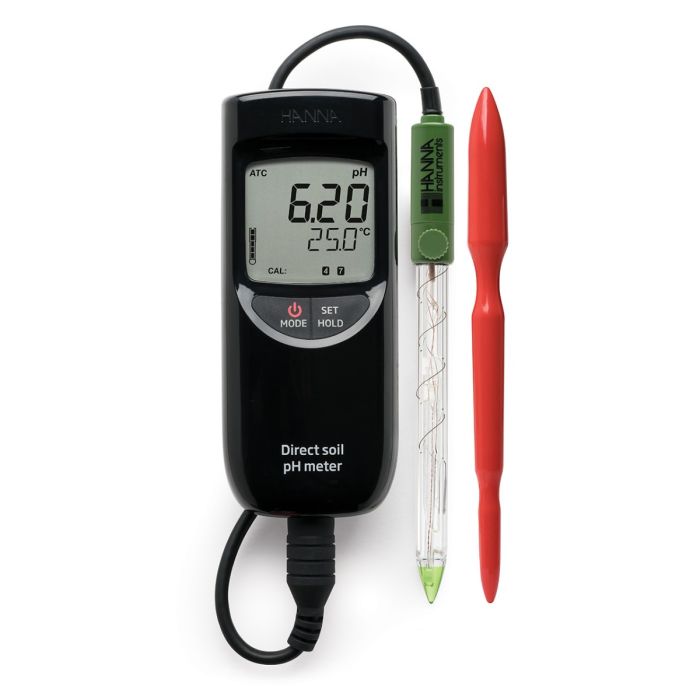
HI99121 Waterproof Portable pH-Temperature Meter [Soil & Agriculture]
-
pH range: -2.00 to 16.00 pH; pH-mV conversion: ±825 mV; Temperature: -5.0 to 105.0°C; 23.0 to 221.0°F
-
Specially designed for pH measurement and analysis of samples in agriculture/horticulture/soil industries
-
Large LCD screen display allows you to easily view pH, pH-mV, temperature readings and instrument performance status from multiple angles; features a dedicated Sensor Check™ function that allows users to check electrode status at any time; built-in amplifier and temperature sensor conical glass pH electrode, new design, rugged and durable, compliant with IP67 waterproof standard (protection against dust and water immersion), portable two-button design, you can quickly perform setup and calibration modes, making the meter easier to operate
-
New exterior design, extra-large dual-line screen display, user-friendly design, ergonomic, good value for money
-
Setup and calibration information prompts, automatic two-point calibration recognition, built-in two sets of standard calibration points
-
Two-button simple operation, 0.01 pH resolution, high-precision measurement, high cost-effectiveness
-
Battery replacement is simple and quick, BEPS low battery error prevention system avoids incorrect measurements
-
Designed for field measurement, excellent waterproof performance
-
Recommended for pH measurement and analysis of samples in agriculture/horticulture/soil industries
| Measuring range | pH | -2.00 to 16.00 pH |
| ℃ | -5.0 to 105.0℃ (23.0 to 221.0℉) | |
| Resolution | pH | 0.01 pH |
| ℃ | 0.1℃, 0.1℉ | |
| Accuracy | pH | ±0.02 pH |
| ℃ | ±0.5℃ (≤60℃), ±1.0℃ (≤105℃) | |
| pH calibration | Automatic 1, 2-point calibration, built-in 2 sets of calibration points | |
| (pH 4.01, 7.01, 10.01 and pH 4.01, 6.86, 9.18) | ||
| Temperature compensation | Automatic temperature compensation: -5.0 to 105℃ | |
| Electrode type | HI1292D glass combination pH electrode with built-in temperature sensor, DIN connector, 1 m cable length | |
| Power supply | 3 x 1.5V AAA batteries, auto power-off after 8 minutes of non-use | |
| Operating environment | 0.0 to 50.0℃ (32.0 to 122.0); max 100%RH | |
| Dimensions & weight | Meter dimensions: 152*58*30 mm, meter weight: 205 g | |
Meter, HI1292D glass combination pH electrode with built-in temperature sensor, HI721319 dedicated soil auger, HI7051H soil sample preparation solution, Chinese and English instruction manual
-
HI99121 is the perfect portable pH meter for soil testing. Using HI99121 and HI12923 direct soil pre-amplified pH and temperature probe, users can test soil pH directly or after preparing a soil slurry with deionized water.
-
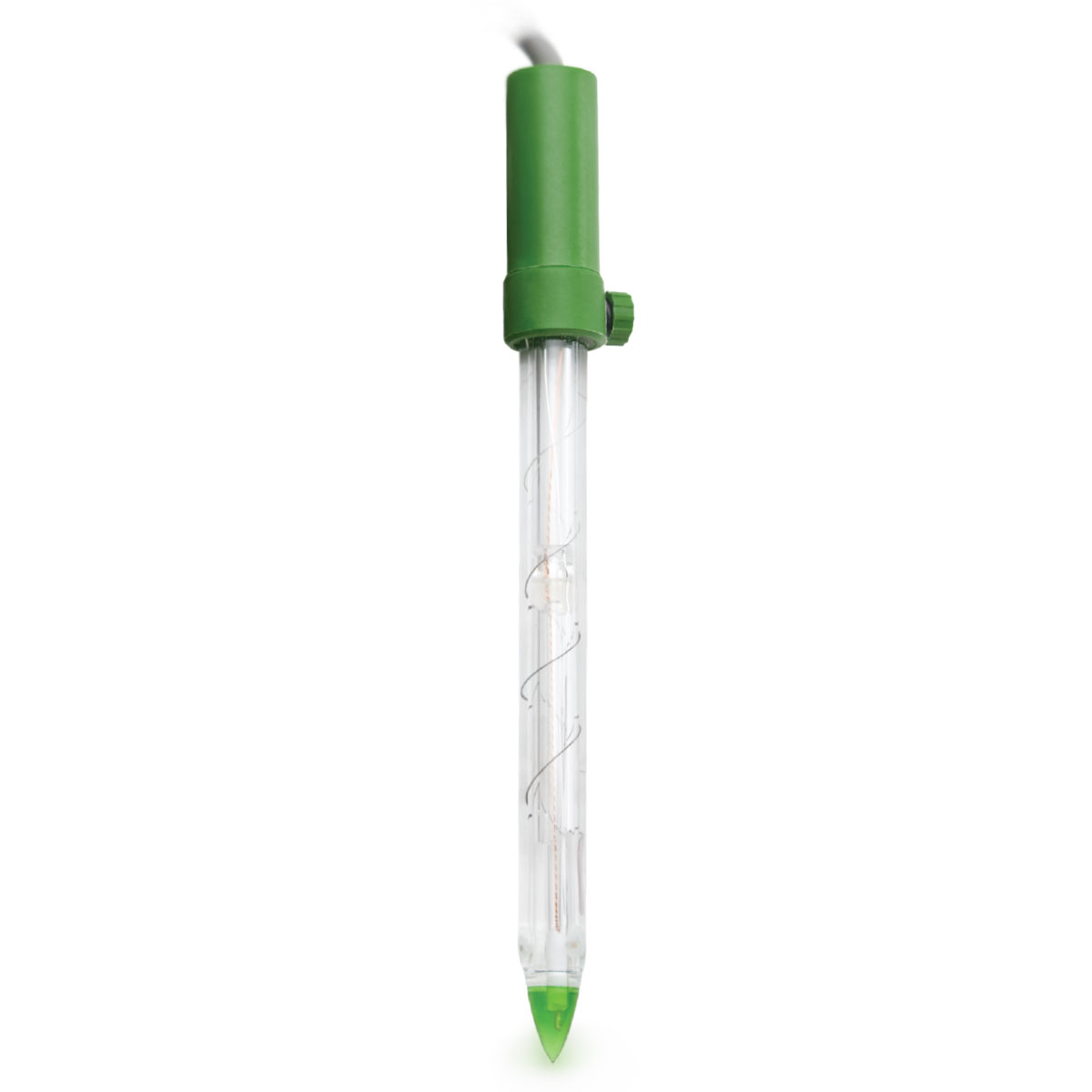
HI12923 features a conical, rugged tip that can be inserted directly into moist or soft soil. For harder soil, the kit includes a plastic auger for drilling into the ground.
-
Automatic temperature compensation
-
Automatic two-point calibration
-
Waterproof

-
Refillable
-
Turn the cap to create positive pressure head, allowing more reference electrolyte to flow.

-
Built-in temperature sensor
-
Automatically compensates for temperature changes.
-
Amplified electrode
-
Fast, stable response, unaffected by humidity-induced electrical noise.
-
Depending on the soil pH, soil can be acidic, neutral, or alkaline. Most plants prefer a pH range of 5.5 to 7.5; but some species prefer acidic or alkaline soil. However, each plant requires a specific pH range for optimal growth.
-
pH strongly affects the availability of nutrients in the soil as well as the presence of microorganisms and plants. For example, fungi prefer acidic conditions, while most bacteria, especially those that provide nutrients to plants, prefer moderately acidic or slightly alkaline soil. In fact, under strongly acidic conditions, nitrogen fixation and mineralization of vegetable residues are reduced. Plants absorb nutrients dissolved in soil water, and the solubility of nutrients depends largely on pH. Therefore, the availability of elements varies at different pH levels.
-
Each plant requires different amounts of elements, which is why each plant needs a specific pH range to optimize its growth. For example, iron, copper, and manganese are insoluble in alkaline environments. This means that plants requiring these elements should theoretically be in acidic soil. On the other hand, nitrogen, phosphorus, potassium, and sulfur are readily available in near-neutral pH ranges. In addition, abnormal pH values can increase toxic element concentrations in plants. For example, under acidic conditions, excessive aluminum ions may be present in amounts that plants cannot tolerate. When pH deviates too far from neutral conditions, it can also negatively affect chemical and physical structure (aggregate breakdown, lower permeability, denser soil).
-
The HI99121 meter features a large multi-level LCD screen that simultaneously displays pH and temperature readings with a resolution of 0.01 pH and accuracy of ±0.02 pH. The LCD screen also features calibration status and stability indicators, as well as on-screen tutorial information. HI99121 has many advanced features found in more expensive portable instruments, including automatic calibration, buffer recognition, and temperature compensation. Battery percentage level is displayed at startup, reminding users of remaining available battery power. The supplied HI12923 is a glass body, amplified pH electrode with built-in temperature sensor, specifically designed for measuring pH in soil.
-
Features at a glance
-
Automatic temperature compensation
-
One or two-point automatic calibration
-
BEPS - alerts user to low battery levels, which may adversely affect readings
-
Compact, durable, waterproof
-
Battery percentage displayed at startup
-
HELP function, displays messages on LCD
-
Note: Use the soil auger on stony ground to prevent damage to the glass probe.
-
For high accuracy and to ensure the soil is moist, use HI7051M soil preparation solution.
| SKU | HI99121 |
|---|---|
| Product Name | Direct Soil Measurement pH Portable Meter - HI99121 |
| Quote Required | Yes |
| pH Range | -2.00 to 16.00 pH; -2.0 to 16.0 pH |
| pH Resolution | 0.01 pH; 0.1 pH |
| pH Accuracy | ±0.02 pH; ±0.1 pH |
| pH Calibration | automatic, at one or two points with two sets of standard buffers (pH 4.01 / 7.01 / 10.01 or pH 4.01 / 6.86 / 9.18) |
| pH Temperature Compensation | automatic ‐5.0 to 105.0 °C/23.0 to 221.0 °F |
| pH CAL Check (electrode diagnostics) | probe condition indicator |
| mV Range | ±825 mV (pH‐mV) |
| mV Resolution | 1 mV |
| mV Accuracy | ±1 mV (pH‐mV) |
| Temperature Range | -5.0 to 105.0°C / 23.0 to 221.0°F |
| Temperature Resolution | 0.1°C / 0.1°F |
| Temperature Accuracy | ±0.5°C (up to 60°C); ±1.0°C (outside) / ±1°F (up to 140°F); ±2.0°F (outside) |
| pH Electrode | HI12923 glass body, pre-amplified pH electrode for soil measurement with internal temperature sensor, quick connect DIN connector and 1 m (3.3’) cable (included) |
| Automatic Shut-Off | user selectable |
| Battery Type/Life | 1.5V (3) AAA / approximately 1400 hours of continuous use; auto-off after 8 minutes of non-use |
| IP Protection | IP67 |
| Environment | 0 to 50°C (32 to 122°F); RH max 100% |
| Dimensions | 154 x 63 x 30 mm (6.1 x 2.5 x 1.2”) |
| Weight | 196 g (6.91 oz.) |
| Ordering Information | HI99121 is supplied with HI12923 pH electrode, HI721319 soil auger, HI7051M soil preparation solution (230 mL), HI70004 pH 4.01 buffer solution sachet (20 mL), HI70007 pH 7.01 buffer solution sachet (20 mL), HI700663 cleaning solution sachet for inorganic soil deposits (20 mL), HI700664 cleaning solution sachet for organic soil deposits (20 mL), 100 mL plastic beaker, batteries, instructions, and a hard carrying case. |
Casos de servicio
Tratamiento de Aguas Residuales Municipales — Hanna: caso de configuración desde stock
Resumen del proyecto
La instalación está en las etapas de entrada, biológica y salida de una planta municipal. El cliente quería configurar bien Hanna en la planta existente, con el objetivo de análisis portátil y de laboratorio con instrumentos Hanna.
Retos técnicos
Lo que realmente da problemas es alto contenido de sólidos y componentes corrosivos, con grandes variaciones diarias de caudal, y los parámetros del efluente oscilan y las sondas se ensucian con lodos y biopelícula. Todo ello implica que la configuración de Hanna deba incluir selección por parámetros, precisión y portabilidad.
Configuración
El suministro y la instalación se organizaron por la vía de stock: configurar desde stock y entregado con rapidez. En planta esto supuso selección por parámetros, precisión y portabilidad; se revisó línea a línea: cumplimiento estable del nivel 1A y reporte de datos en línea.
Comportamiento
Tras la puesta en marcha el resultado es resultados in situ, con menos verificaciones de laboratorio, y las lecturas se usan ya para ajustar el proceso.
Alimentación y Bebidas — Hanna: caso de configuración desde stock
Situación en planta
Se trata de un cliente del sector Alimentación y Bebidas cuya planta está en las etapas de dosificación, pasteurización, llenado y limpieza CIP. La tarea principal era análisis portátil y de laboratorio con instrumentos Hanna.
El problema
La dificultad está en jarabes, lácteos y bebidas proclives a incrustaciones, con estrictos requisitos higiénicos; a la vez, las limpiezas frecuentes exigen instrumentos resistentes a ciclos CIP/SIP con sosa caliente. Por eso la especificación implica selección por parámetros, precisión y portabilidad.
Qué hicimos
Adoptamos un enfoque de stock: configurar desde stock y entregado con rapidez. La entrega se construyó en torno a selección por parámetros, precisión y portabilidad; se verificó punto por punto: requisitos de seguridad alimentaria y diseño higiénico 3-A / EHEDG.
Resultado operativo
En servicio el sistema responde a lo previsto: resultados in situ, con menos verificaciones de laboratorio, con un mantenimiento rutinario notablemente menor.
Química y Farmacéutica — Hanna: caso de configuración desde stock
Contexto de aplicación
reactores, vasijas de dosificación y tanques de producto terminado es un servicio típico de Química y Farmacéutica. El proyecto partió de Hanna, centrándose en análisis portátil y de laboratorio con instrumentos Hanna.
Limitaciones del proceso
la corrosión y la protección Ex acortan la vida útil y encarecen las paradas, y medios muy corrosivos con disolventes y cristalización, en parte en atmósferas explosivas no hace sino acentuarlo. Por eso la especificación de Hanna debe cubrir selección por parámetros, precisión y portabilidad.
Enfoque de suministro
La entrega se gestionó como stock: configurar desde stock y entregado con rapidez. La ejecución se centró en selección por parámetros, precisión y portabilidad, junto con certificación Ex y trazabilidad de datos según GMP.
Resultados en campo
La operación evidencia el beneficio: resultados in situ, con menos verificaciones de laboratorio, con una confianza claramente mayor en este punto de medición.
Energía y Electricidad — Hanna: caso de configuración desde stock
Perfil del cliente
El entorno típico en Energía y Electricidad es agua de alimentación, condensado de turbina y sistemas de desulfuración/DeNOx. El punto de medición es Hanna; el foco es análisis portátil y de laboratorio con instrumentos Hanna.
Dificultades clave
Las condiciones son alta temperatura y presión, con vapor y agua salina y, encima, deriva a alta temperatura y presión, con paradas no programadas muy costosas, algo que una configuración estándar no soporta mucho tiempo. El diseño parte de selección por parámetros, precisión y portabilidad.
Implementación
El alcance se canalizó por la vía de stock: configurar desde stock y entregado con rapidez. Técnicamente se apoya en selección por parámetros, precisión y portabilidad, y en estos requisitos: cumplimiento de normativas del sector y objetivos de disponibilidad.
Beneficio para el cliente
En la práctica esto significa resultados in situ, con menos verificaciones de laboratorio, lo que redujo la carga del equipo de mantenimiento.
Recomendados similares
 HANNA Instruments
Medidor de conductividad portátil de rangos múltiples
 HANNA Instruments
Fotómetro portátil de nitrógeno amoniacal de rango bajo
 HANNA Instruments
Turbidímetro portátil de rangos múltiples
 HANNA Instruments
Medidor de salinidad para acuarios de agua salada
 HANNA Instruments
Analizador portátil de color de miel
HANNA InstrumentsFotómetro portátil de cloro libre
 HANNA Instruments
Fotómetro portátil de cloro residual y total
 HANNA Instruments