Technical Data
ComparePoint Level / Solids
| Measuring Principle | Paddle |
| Characteristic / Application | universally applicable as a full, empty and demand alarm on silos containing solids |
| Specialities | Rotation Monitoring System Fold-away paddle |
| Supply / Communication | 230 VAC 50/60 Hz 115 VAC 50/60 Hz 24 VAC 50/60 Hz 20 bis 28 VDC |
| Ambient temperature | -20 °C ... 60 °C (-4 °F ... 140 °F) |
| Process temperature | -20 °C ... 80 °C (-4 °F ... 170 °F) |
| Process pressure / max. overpressure limit | 0.5 bar to 1.5 bar (7 psi ... 22 psi) |
| Min. density of medium | >= 80 g/l |
| Main wetted parts | 1.4305 |
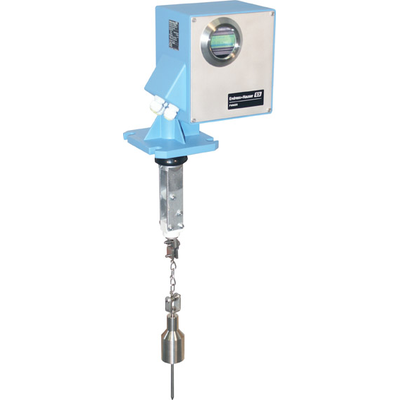
| Max. tensile strength | Rope version >1500N |
| Process connection | NPT 1 1/2", PBT NPT 1 1/4", PBT G 1 1/2", PBT NPT 1 1/2", 1.4305 NPT 1 1/4", 1.4305 G 1 1/2", 1.4305 |
| Sensor length | 75 mm (3") 100 mm (4") 120 mm (4 3/4") 200 mm (8") 300 mm (12") Rope length of approx 2000 mm (80"), can be shortened |
| Communication | Micro switch with changeover contact max. 10 A/250 VAC |
| Certificates / Approvals | ATEX II1/2D Ex ta/tb IIIC Da/Db CSA DIP/ II, III/1/E-G FM DIP/ II, III/1/E-G EAC Ex ta/tb IIIC Da/Db IECEx Ex ta/tb IIIC Da/Db NEPSI Ex tD A20/A21 UK II1/2D Ex ta/tb IIIC Da/Db INMETRO Ex ta/tb IIIC Da/Db Non-hazardous area + KC marking |
| Options | Rotation Monitoring System Signal Lamp Fold-away paddle Weather protection cover |
| Components | HAW569 Surge arrester |
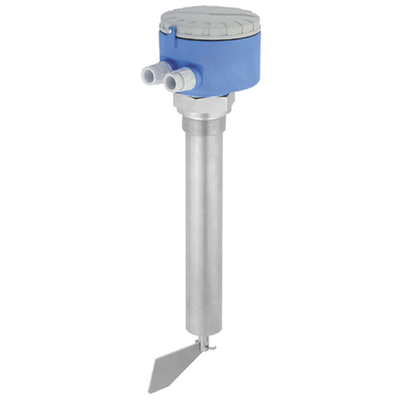
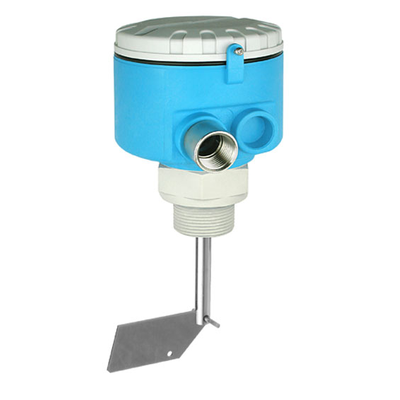
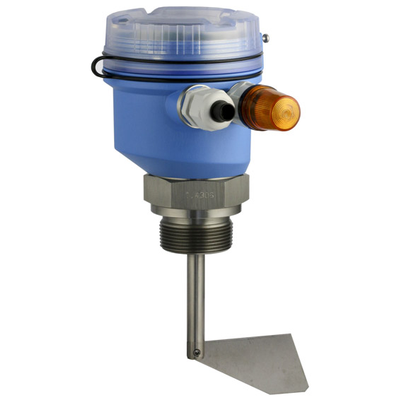
The economical Soliswitch FTE20 is a paddle-type level switch for limit detection of bulk solids. The robust polymer housing and one-piece design make it the ideal sensor for detecting full, empty and demand states of bulk solids. The device uses an optimized polymer material and robust construction and complies with the latest standards, suitable for dust explosion hazardous areas.
-
Advantages
-
The device features a tool-free fault self-test function and automatic rotation monitoring, offering excellent value for money
-
Economical paddle-type limit switch for solids granule measurement, Ex approved
-
Suitable for dust explosion hazardous areas and complies with the highest safety standards
-
The switch adjusts automatically to the weight of the solids, without tools
-
The device housing can be rotated 360 ° to ensure the best installation position
-
Easy installation
-
Robust plastic housing with transparent cap
-
Areas of application
-
Process connections: NPT 1½", PBT; NPT 1¼", PBT; G 1½", PBT; NPT 1½", 1.4305; NPT 1¼", 1.4305; G 1½", 1.4305
-
Sensor length: various standard lengths between 100 mm (4") and 600 mm (24"), rope extension length 2000 mm (80") (adjustable)
-
Ambient temperature: -20...+80 °C (-4...+170 °F)
-
Process pressure range (absolute): 0.5...2.5 bar (7...36 psi)
-
ATEX II 1/3 D, CSA DIP/ II, III/1/E-G, FM DIP/ II, III/1/E-G
Spare Parts & Accessories 12
12 spare parts · click to collapse
| Order code | Description | |
|---|---|---|
| 71418346 | cover | Details |
| 71418318 | hinge leaf | Details |
| 71418342 | double blade | Details |
| 71418345 | Extension cable | Details |
| 71572490 | Set universal joint rope extension FTE20Packing unit: 2 pieces | Details |
| 71418344 | signal lamp | Details |
| 71528394 | Lamp set E14 24-28VDC/24VACPacking unit: 5 pieces | Details |
| 71528395 | Lamp set E14 115VACPacking unit: 5 pieces | Details |
| 71528396 | Lamp set E14 230VACPacking unit: 5 pieces | Details |
| 71397409 | FTE20 protective cover | Details |
| 71418347 | Flange type | Details |
| 71505353 | Resistive coupling element 1K/10K | Details |
Configurator / Comparison
Source:Endress+Hauserwebsite public information
Manuals & Documents 4
All documents for this modelCase Studies
Municipal Wastewater Treatment · rotary — Application Case
Customer Profile
The typical setting in Municipal Wastewater Treatment is the inlet, biological and outlet stages of a municipal plant. The measuring point is rotary; the focus is rotating-paddle high and low level detection in silos.
Key Difficulties
Conditions are high solids and corrosive fractions, with large diurnal flow swings and, on top of that, effluent parameters drift and probes foul with sludge and biofilm, which a standard configuration cannot handle for long. The design therefore starts with choosing paddle and bearing type by bulk density, particle size and temperature.
Implementation
The scope ran through the level range: level solution matched to the actual tank and silo geometry. Technically it hinges on choosing paddle and bearing type by bulk density, particle size and temperature, and on these requirements: stable compliance with Grade 1A discharge limits and online data reporting.
Customer Benefit
In practice this means maintenance-free in dusty duty, with timely blockage alarms, which cut the workload on the site maintenance team.
Food & Beverage · rotary — Application Case
Project Background
The project covers dosing, pasteurising, filling and CIP stages. The work centres on rotary and the core task is rotating-paddle high and low level detection in silos.
Operating Challenges
The medium and duty are characterised by syrups, dairy and beverages that scale easily, under strict hygienic requirements, and frequent cleaning demands instruments that withstand hot CIP/SIP caustic cycles. So rotary cannot be specified generically — it calls for choosing paddle and bearing type by bulk density, particle size and temperature.
Solution
The Ainstru engineering team worked through the level range: level solution matched to the actual tank and silo geometry. The configuration involves choosing paddle and bearing type by bulk density, particle size and temperature, with these requirements in view: food-safety and hygienic design per 3-A / EHEDG.
Results
Since start-up the system has run steadily; the practical result is maintenance-free in dusty duty, with timely blockage alarms.
Chemical & Pharmaceutical · rotary — Application Case
Project Overview
The site is reactors, metering vessels and finished-product tanks. The customer wanted rotary properly configured on the existing plant, with the aim of rotating-paddle high and low level detection in silos.
Technical Challenges
What actually causes trouble is highly corrosive media with solvents and crystallisation, partly in explosive atmospheres, and corrosion plus Ex protection shortens instrument life and makes downtime costly. All of this means the rotary configuration has to involve choosing paddle and bearing type by bulk density, particle size and temperature.
Configuration
Supply and installation were organised through the level range: level solution matched to the actual tank and silo geometry. On site this meant choosing paddle and bearing type by bulk density, particle size and temperature, checked line by line against: Ex certification and GMP traceability of records.
Performance
After commissioning the outcome is maintenance-free in dusty duty, with timely blockage alarms, and the readings are now used for process tuning.
Power & Energy · rotary — Application Case
Site Conditions
This is a Power & Energy customer whose plant is at boiler feedwater, turbine condensate and FGD/DeNOx systems. The main task was rotating-paddle high and low level detection in silos.
The Problem
The difficulty lies in high temperature and pressure with both steam and saline water; at the same time drift under high temperature and pressure, with very costly unplanned outages. Specification therefore means choosing paddle and bearing type by bulk density, particle size and temperature.
What We Did
We took a level range approach — level solution matched to the actual tank and silo geometry. Delivery was built around choosing paddle and bearing type by bulk density, particle size and temperature, with point-by-point checks on: compliance with power-industry codes and unit availability targets.
Operating Outcome
In service the system performs as intended — maintenance-free in dusty duty, with timely blockage alarms, with routine maintenance falling noticeably.