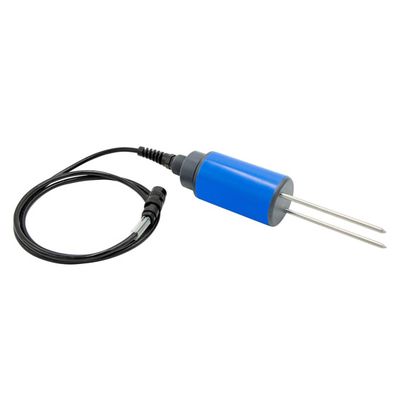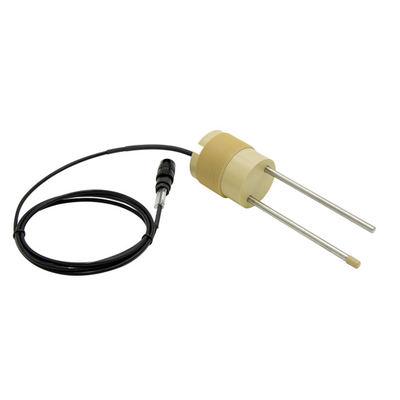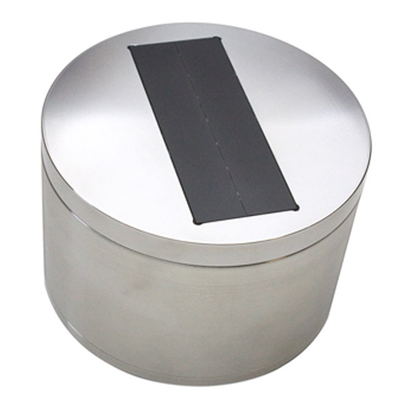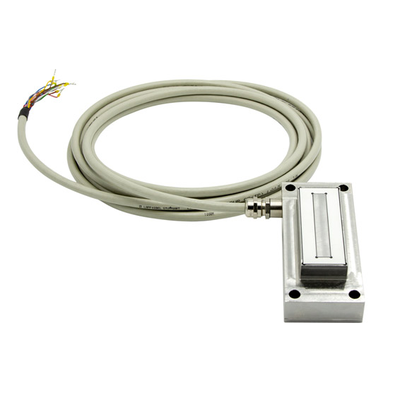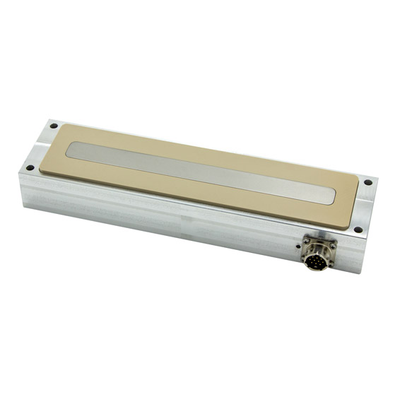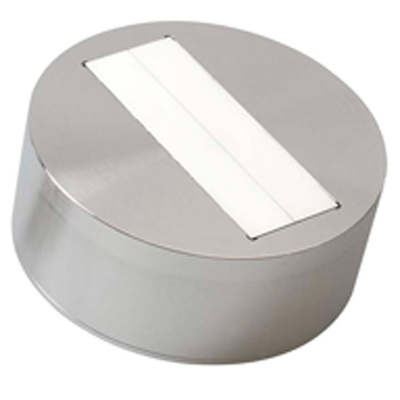
Technical Data
CompareMoisture in bulk solids
| Measuring Principle | Guided radar |
| Application | Moisture measurement in heterogeneous bulk solids with the density from 0.8...2 g/ cm³ like sand, gravel or gritt |
| Measuring method | Contact inline measurement |
| Measuring range | Recommended moisture range %/ vol.: 0...100 % |
| Material permeation depth | Up to 45 mm (0.15 ft) |
| Consistency of the sample | Conductivity range: 0…max. 5 mS/ cm |
| Temperature sensor | Yes |
| Process temperature | 0…+120°C (+32°F...+248°F) |
| Accuracy | Up to +/-0.1 % abs. |
| Output / communication | 0...20 mA 4...20 mA |
| Options | Remote display Sensor cables Baffle plate Universal holder Sliding carriage |
Our guided radar moisture sensors are highly wear-resistant and robust, minimizing the workload of secondary calibration, while real-time moisture measurement saves operating costs. Reliable moisture measurement helps improve product quality and reduce energy consumption.
Advantages
Easy commissioning even under demanding conditions
Strong material penetration (45 mm)
Wide moisture measuring range (0...100%)
Various installation accessories available
Remote electronics permit process temperatures up to 120°C
Built-in transmitter for convenient factory integration
Application areas
Moisture measurement of bulk solids with a medium density range of 0.8…2 g/cm3, e.g. sand, gravel, grit
Configurator / Comparison
Accessories / Spare parts
A
A
Source:Endress+Hauserpublic information from the website
Manuals & Documents 4
All documents for this modelCase Studies
Municipal Wastewater Treatment · humidity level — Application Case
Project Background
The project covers the inlet, biological and outlet stages of a municipal plant. The work centres on humidity level and the core task is measuring gas humidity or dew point for drying and process control.
Operating Challenges
The medium and duty are characterised by high solids and corrosive fractions, with large diurnal flow swings, and effluent parameters drift and probes foul with sludge and biofilm. So humidity level cannot be specified generically — it calls for choosing sensor type by dew-point range, pressure and corrosivity.
Solution
The Ainstru engineering team worked through the analyser range: selecting as part of a complete water-analysis system. The configuration involves choosing sensor type by dew-point range, pressure and corrosivity, with these requirements in view: stable compliance with Grade 1A discharge limits and online data reporting.
Results
Since start-up the system has run steadily; the practical result is controlled dew point, improving both product quality and energy use.
Food & Beverage · humidity level — Application Case
Project Overview
The site is dosing, pasteurising, filling and CIP stages. The customer wanted humidity level properly configured on the existing plant, with the aim of measuring gas humidity or dew point for drying and process control.
Technical Challenges
What actually causes trouble is syrups, dairy and beverages that scale easily, under strict hygienic requirements, and frequent cleaning demands instruments that withstand hot CIP/SIP caustic cycles. All of this means the humidity level configuration has to involve choosing sensor type by dew-point range, pressure and corrosivity.
Configuration
Supply and installation were organised through the analyser range: selecting as part of a complete water-analysis system. On site this meant choosing sensor type by dew-point range, pressure and corrosivity, checked line by line against: food-safety and hygienic design per 3-A / EHEDG.
Performance
After commissioning the outcome is controlled dew point, improving both product quality and energy use, and the readings are now used for process tuning.
Chemical & Pharmaceutical · humidity level — Application Case
Site Conditions
This is a Chemical & Pharmaceutical customer whose plant is at reactors, metering vessels and finished-product tanks. The main task was measuring gas humidity or dew point for drying and process control.
The Problem
The difficulty lies in highly corrosive media with solvents and crystallisation, partly in explosive atmospheres; at the same time corrosion plus Ex protection shortens instrument life and makes downtime costly. Specification therefore means choosing sensor type by dew-point range, pressure and corrosivity.
What We Did
We took a analyser range approach — selecting as part of a complete water-analysis system. Delivery was built around choosing sensor type by dew-point range, pressure and corrosivity, with point-by-point checks on: Ex certification and GMP traceability of records.
Operating Outcome
In service the system performs as intended — controlled dew point, improving both product quality and energy use, with routine maintenance falling noticeably.
Power & Energy · humidity level — Application Case
Application Context
boiler feedwater, turbine condensate and FGD/DeNOx systems is a typical Power & Energy duty. The project started from humidity level, focusing on measuring gas humidity or dew point for drying and process control.
Process Constraints
drift under high temperature and pressure, with very costly unplanned outages, and high temperature and pressure with both steam and saline water only amplify it. The humidity level specification must therefore cover choosing sensor type by dew-point range, pressure and corrosivity.
Delivery Approach
Delivery was handled as the analyser range — selecting as part of a complete water-analysis system. Execution centred on choosing sensor type by dew-point range, pressure and corrosivity, together with compliance with power-industry codes and unit availability targets.
Field Results
Operation shows the benefit clearly — controlled dew point, improving both product quality and energy use, with confidence in this measuring point improving markedly.