
Product Overview
-
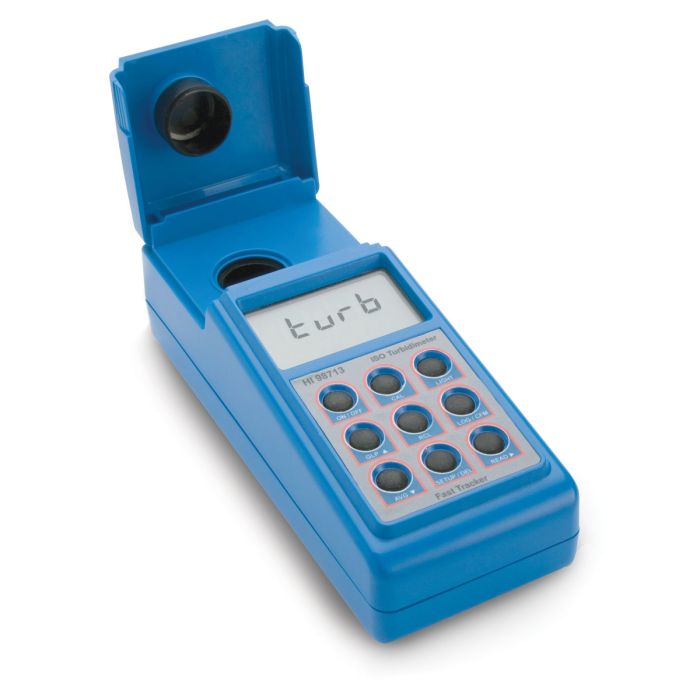
HI98713 is a high-precision portable turbidity meter. This meter is supplied with AMCO-AEPA-1 primary turbidity standards for calibration and performance verification. HI98713 meets and exceeds the requirements of the ISO 7027 turbidity measurement method.
-
Fast Tracker™ - Tag Identification System (T.I.S)
-
USB for data transfer
-
Up to four-point calibration
-
Skip to the end of the image gallery
-
Skip to the beginning of the image gallery
-
More information
-
The HI98713 precision ISO turbidity portable meter is designed specifically for water quality measurement, providing reliable and accurate readings
-
The HI98713 precision ISO turbidity portable meter is designed specifically for water quality measurement, providing reliable and accurate readings even in the low turbidity range. The instrument is based on a state-of-the-art optical system that ensures accurate results, ensures long-term stability, and minimizes stray light and color interference. Regular calibration using the supplied standards compensates for any variation in the intensity of the LED light source. The 25 mm round cuvette made of special optical glass guarantees the repeatability of turbidity measurements.
-
Features at a glance
-
Ratio measurement mode - HI98713 uses the ratio method to measure turbidity, using 90° and 180° light detectors for more accurate measurements. Turbidity measurement can be performed in the range of 0.00 to 1000 FNU.
-
Multiple reading modes - Normal measurement, continuous measurement, or signal averaging measurement are available reading modes.
-
ISO compliant - HI98713 meets and exceeds the requirements of the ISO 7027 method for measuring turbidity using an infrared LED light source.
-
Calibration – HI98713 features a powerful calibration function that compensates for changes in light intensity. Calibration can be performed using the supplied calibration solutions or user-prepared standards. Two-point, three-point, or four-point turbidity calibration can be performed using the supplied (<0.1, 15, 100 and 750 FNU) standards. If user-prepared standards are used, the calibration points can be modified.
-
AMCO AEPA-1 primary turbidity standards - The standards provided by AMCO AEPA-1 are recognized by the US EPA as primary standards. These non-toxic standards are made of styrene-divinylbenzene polymer spheres of uniform size and density. These standards are reusable and stable with a long shelf life.
-
Fast Tracker™ - For advanced field applications, the HI98713 is equipped with the Fast Tracker? - Tag Identification System (T.I.S.), making data collection and management easier than ever. Fast Tracker™ allows users to record the time and location of a specific measurement or series of measurements using iButton® tags near the sampling point for quick and easy reading. Each iButton® tag contains a computer chip encapsulated in stainless steel with a unique identification code.
-
GLP data – HI98713 features full GLP (Good Laboratory Practice) functionality for traceable calibration conditions. Data includes calibration points, date, and time.
-
Data logging - Up to 200 measurement values can be stored in internal memory and recalled at any time.
-
Data transfer – For further storage or analysis, recorded data can be downloaded to a Windows®-compatible PC using the USB or RS232 port and HI92000 software.
-
Backlit graphic LCD display – The graphic LCD display provides an easy-to-understand, user-friendly interface. All information is in plain text for easy reading.
-
Significance of use
-
Turbidity is one of the most important parameters in determining the quality of drinking water. Once considered primarily an aesthetic characteristic of drinking water, there is important evidence that controlling turbidity is an effective safeguard against pathogens. In natural waters, turbidity measurement is performed to measure general water quality and its compatibility in applications involving aquatic organisms. Monitoring and treatment of wastewater was once based entirely on turbidity control. Currently, it is necessary to measure turbidity at the end of the wastewater treatment process to verify that its value is within regulatory standards.
-
Turbidity of water is an optical property that causes light to be scattered and absorbed rather than transmitted. The scattering of light passing through a liquid is mainly caused by the presence of suspended solids. The higher the turbidity, the greater the amount of scattered light. Even very pure liquids scatter light to some extent, because no solution has zero turbidity.
-
The ISO turbidity measurement standard uses light at infrared wavelengths outside the visible spectrum. The main advantage of the ISO method compared to the EPA method is reduced color interference. The EPA method uses a tungsten lamp, which produces light containing all visible wavelengths of what we see as white light. Colored solutions will absorb light at complementary wavelengths, which will affect turbidity readings. Since the ISO method is outside the visible wavelengths, color in the sample will not interfere with the measurement. The US EPA prefers tungsten lamps because they provide better accuracy in the low range, and drinking water should not be colored. According to ISO 7027, the requirements for optical turbidimeters used to measure scattered radiation in low-range measurements (i.e., drinking water), expressed in formazin nephelometric units (FNU), are:
-
Measurement of scattered radiation in low turbidity water (0 FNU to 40 FNU)
-
The wavelength of the incident radiation shall be 860 nm
-
The spectral bandwidth of the incident radiation shall be less than or equal to 60 nm
-
The parallelism of the incident radiation shall not exhibit divergence, and any convergence shall not exceed 1.5°.
-
The measurement angle θ between the optical axis of the incident radiation and the optical axis of the scattered radiation shall be 90°±2.5°.
-
The aperture angle in the water sample shall be between 20° and 30°.
-
HI98713 meets and exceeds the instrument standards specified in ISO 7027.
-
Operating principle
-
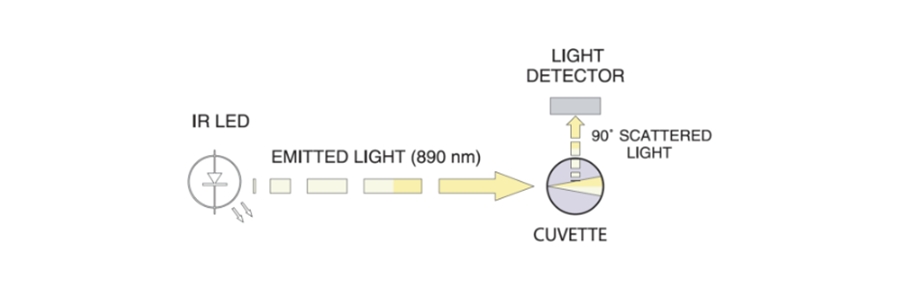
The light beam passing through the sample is scattered in all directions. The intensity and pattern of the scattered light are affected by many variables, such as the wavelength of the incident light, particle size and shape, refractive index, and color. The optical system of the HI98713 includes an LED, a scattered light detector (90°), and a transmitted light detector (180°). The detector used is based on the measurement mode.
-
The lower detection limit of a turbidimeter is determined by the stray light detected by the sensor that is not caused by light scattering from suspended particles. The optical system of the HI98713 is designed to have very low stray light, providing highly accurate results for low turbidity samples.
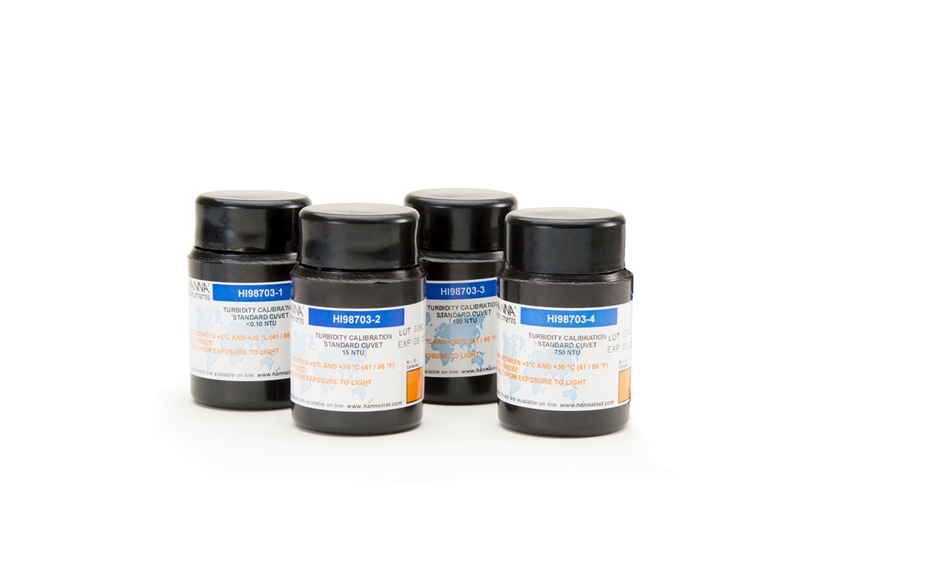
HI98713-11 AMCO AEPA-1 standards ensure that measurements are traceable to primary reference materials. These standards are used for calibration and performance verification of turbidity meters.
-
Certificate of analysis provided
-
Lot number
-
Expiration date
-
Standard value at 25°C
-
NIST traceable reference instrument
-
Storage container provided
-
Light-proof
-
Protects against accidental breakage
| SKU | HI98713-02 |
|---|---|
| Product Name | Turbidity (ISO) Portable Meter - HI98713 |
| Quote Required | Yes |
| FNU Range | 0.00 to 9.99 FNU |
| FNU Range | 10.0 to 99.9 FNU |
| FNU Range | 100 to 1000 FNU |
| FNU Resolution | 0.01 FNU from 0.00 to 9.99 FNU |
| FNU Resolution | 0.1 FNU from 10.0 to 99.9 FNU |
| FNU Resolution | 1 FNU from 100 to 1000 FNU |
| FNU Accuracy | ±2% of reading plus 0.1 FNU |
| Range Selection | Automatic |
| Turbidity Repeatability | ±1% of reading or 0.01 FNU, whichever is greater |
| Stray Light | < 0.1 FNU |
| Typical EMC Deviation | ±0.05 FNU |
| Turbidity Light Detector | 860 nm infrared LED |
| IR Detector | Silicon Photocell |
| Turbidity Method | Adaptation of ISO 7027, ratio method with 90° and 180° detector. |
| Turbidity Standards | < 0.1, 15, 100 and 750 FNU |
| Calibration | Two, three or four point calibration |
| Display | 60 x 90 mm LCD with backlight |
| LOG Memory | 200 records |
| Serial Interface | RS232 and USB 1.1 |
| Environment | 0 to 50°C (32 to 122°F); max 95% RH non-condensing |
| Power Supply | 4 x 1.5V AA alkaline batteries or AC adapter |
| Auto Shut-Off | After 15 minutes of non-use |
| Dimensions | 224 x 87 x 77 mm (8.8 x 3.4 x 3.0”) |
| Weight | 512 g (18 oz.) |
| Warranty | 2 years |
Case Studies
Municipal Wastewater Treatment · Hanna — Stock Configuration Case
Project Overview
The site is the inlet, biological and outlet stages of a municipal plant. The customer wanted Hanna properly configured on the existing plant, with the aim of covering portable and laboratory water testing with Hanna instruments.
Technical Challenges
What actually causes trouble is high solids and corrosive fractions, with large diurnal flow swings, and effluent parameters drift and probes foul with sludge and biofilm. All of this means the Hanna configuration has to involve selected by parameter set, accuracy and field portability.
Configuration
Supply and installation were organised through the stock channel: configuring from stock and delivered quickly. On site this meant selected by parameter set, accuracy and field portability, checked line by line against: stable compliance with Grade 1A discharge limits and online data reporting.
Performance
After commissioning the outcome is results available on site, reducing lab re-checks, and the readings are now used for process tuning.
Food & Beverage · Hanna — Stock Configuration Case
Site Conditions
This is a Food & Beverage customer whose plant is at dosing, pasteurising, filling and CIP stages. The main task was covering portable and laboratory water testing with Hanna instruments.
The Problem
The difficulty lies in syrups, dairy and beverages that scale easily, under strict hygienic requirements; at the same time frequent cleaning demands instruments that withstand hot CIP/SIP caustic cycles. Specification therefore means selected by parameter set, accuracy and field portability.
What We Did
We took a stock channel approach — configuring from stock and delivered quickly. Delivery was built around selected by parameter set, accuracy and field portability, with point-by-point checks on: food-safety and hygienic design per 3-A / EHEDG.
Operating Outcome
In service the system performs as intended — results available on site, reducing lab re-checks, with routine maintenance falling noticeably.
Chemical & Pharmaceutical · Hanna — Stock Configuration Case
Application Context
reactors, metering vessels and finished-product tanks is a typical Chemical & Pharmaceutical duty. The project started from Hanna, focusing on covering portable and laboratory water testing with Hanna instruments.
Process Constraints
corrosion plus Ex protection shortens instrument life and makes downtime costly, and highly corrosive media with solvents and crystallisation, partly in explosive atmospheres only amplify it. The Hanna specification must therefore cover selected by parameter set, accuracy and field portability.
Delivery Approach
Delivery was handled as the stock channel — configuring from stock and delivered quickly. Execution centred on selected by parameter set, accuracy and field portability, together with Ex certification and GMP traceability of records.
Field Results
Operation shows the benefit clearly — results available on site, reducing lab re-checks, with confidence in this measuring point improving markedly.
Power & Energy · Hanna — Stock Configuration Case
Customer Profile
The typical setting in Power & Energy is boiler feedwater, turbine condensate and FGD/DeNOx systems. The measuring point is Hanna; the focus is covering portable and laboratory water testing with Hanna instruments.
Key Difficulties
Conditions are high temperature and pressure with both steam and saline water and, on top of that, drift under high temperature and pressure, with very costly unplanned outages, which a standard configuration cannot handle for long. The design therefore starts with selected by parameter set, accuracy and field portability.
Implementation
The scope ran through the stock channel: configuring from stock and delivered quickly. Technically it hinges on selected by parameter set, accuracy and field portability, and on these requirements: compliance with power-industry codes and unit availability targets.
Customer Benefit
In practice this means results available on site, reducing lab re-checks, which cut the workload on the site maintenance team.
Related Products
 HANNA Instruments
Portable multi-range conductivity meter
 HANNA Instruments
Low range ammonia nitrogen portable photometer
 HANNA Instruments
Saltwater aquarium salinity meter
 HANNA Instruments
Portable multi-range turbidimeter
 HANNA Instruments
Portable honey color analyzer
HANNA InstrumentsPortable free chlorine photometer
 HANNA Instruments
Portable free and total chlorine photometer
 HANNA Instruments