
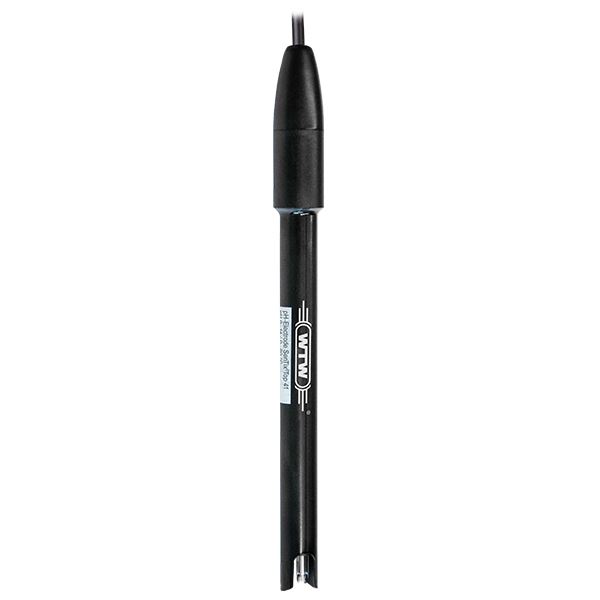
SenTix® Top 41 & 46 pH Electrodes
Polymer Electrolyte - Double Reference System - Cylinder
SenTix® Top 41 & 46: pH Electrodes with Double Reference System and Polymer Electrolyte for pH measuring in lab, field and process
| Variants | ||||
| Art.-No. | Name | Attributes | ||
| 103816 | SenTix® Top 41 | 1 m fixed cable with waterproof DIN plug and 4 mm banana plug | ||
| 103817 | SenTix® Top 46 | 1 m fixed cable with BNC plug and RCA plug | ||
Highlights:
- PEEK shaft for maximum mechanical and chemical resistance
- most precise measurements thanks to process-proven membrane glasses and reference system
- maximum operation life thanks to a reference electrode with finely dispersed KCl solid electrolyte (Duralid®) and a double reference system
The SenTix® Top 41 & 46 electrodes are developed for a wide range of applications in the laboratory, field and process from wastewater to emulsions, solutions with proteins, suspensions to purely aqueous samples. This is achieved through the special mechanical and chemical resistance of the PEEK shaft as well as the process-proven components of the measuring and reference electrode.
The reference electrode has a double junction system with a hole diaphragm and a labyrinth-like reference element. Through this design clogging of the diaphragm and poisoning of the reference system are made considerably more difficult. The saturation with finely dispersed KCl of the solid Duralid® reference electrolyte is another reason for the long zero-point stability and the associated long operation life of the SenTix® Top 41 and Top 46 electrodes. The small hole furthermore reduces the loss of KCl through bleeding, for example, and allows a fast response time.
-
SenTix® Top 41 Top 46 Order no. 103816 103817 Membrane shape Cylindric Shaft PEEK shaft / Plastic Diaphragm Hole - Double reference system Temp. sensor NTC 30 kOhm Reference electrolyte Duralid® Membrane resistance < 400 MΩ Measuring range 0 … 14 pH Temp. range -5 … 100 °C Shaft length 120 mm Shaft diameter 12 mm Connection 1 m fixed cable with waterproof DIN plug and 4 mm banana plug 1 m fixed cable with BNC plug and RCA plug
Case Studies
Municipal Wastewater Treatment · WTW — Stock Configuration Case
Customer Profile
The typical setting in Municipal Wastewater Treatment is the inlet, biological and outlet stages of a municipal plant. The measuring point is WTW; the focus is covering online and laboratory water analysis with WTW instruments.
Key Difficulties
Conditions are high solids and corrosive fractions, with large diurnal flow swings and, on top of that, effluent parameters drift and probes foul with sludge and biofilm, which a standard configuration cannot handle for long. The design therefore starts with selected by parameter set, range and digital sensor protocol.
Implementation
The scope ran through the stock channel: configuring from stock and delivered quickly. Technically it hinges on selected by parameter set, range and digital sensor protocol, and on these requirements: stable compliance with Grade 1A discharge limits and online data reporting.
Customer Benefit
In practice this means plug-and-play digital sensors that keep calibration when swapped, which cut the workload on the site maintenance team.
Food & Beverage · WTW — Stock Configuration Case
Project Background
The project covers dosing, pasteurising, filling and CIP stages. The work centres on WTW and the core task is covering online and laboratory water analysis with WTW instruments.
Operating Challenges
The medium and duty are characterised by syrups, dairy and beverages that scale easily, under strict hygienic requirements, and frequent cleaning demands instruments that withstand hot CIP/SIP caustic cycles. So WTW cannot be specified generically — it calls for selected by parameter set, range and digital sensor protocol.
Solution
The Ainstru engineering team worked through the stock channel: configuring from stock and delivered quickly. The configuration involves selected by parameter set, range and digital sensor protocol, with these requirements in view: food-safety and hygienic design per 3-A / EHEDG.
Results
Since start-up the system has run steadily; the practical result is plug-and-play digital sensors that keep calibration when swapped.
Chemical & Pharmaceutical · WTW — Stock Configuration Case
Project Overview
The site is reactors, metering vessels and finished-product tanks. The customer wanted WTW properly configured on the existing plant, with the aim of covering online and laboratory water analysis with WTW instruments.
Technical Challenges
What actually causes trouble is highly corrosive media with solvents and crystallisation, partly in explosive atmospheres, and corrosion plus Ex protection shortens instrument life and makes downtime costly. All of this means the WTW configuration has to involve selected by parameter set, range and digital sensor protocol.
Configuration
Supply and installation were organised through the stock channel: configuring from stock and delivered quickly. On site this meant selected by parameter set, range and digital sensor protocol, checked line by line against: Ex certification and GMP traceability of records.
Performance
After commissioning the outcome is plug-and-play digital sensors that keep calibration when swapped, and the readings are now used for process tuning.
Power & Energy · WTW — Stock Configuration Case
Site Conditions
This is a Power & Energy customer whose plant is at boiler feedwater, turbine condensate and FGD/DeNOx systems. The main task was covering online and laboratory water analysis with WTW instruments.
The Problem
The difficulty lies in high temperature and pressure with both steam and saline water; at the same time drift under high temperature and pressure, with very costly unplanned outages. Specification therefore means selected by parameter set, range and digital sensor protocol.
What We Did
We took a stock channel approach — configuring from stock and delivered quickly. Delivery was built around selected by parameter set, range and digital sensor protocol, with point-by-point checks on: compliance with power-industry codes and unit availability targets.
Operating Outcome
In service the system performs as intended — plug-and-play digital sensors that keep calibration when swapped, with routine maintenance falling noticeably.


