
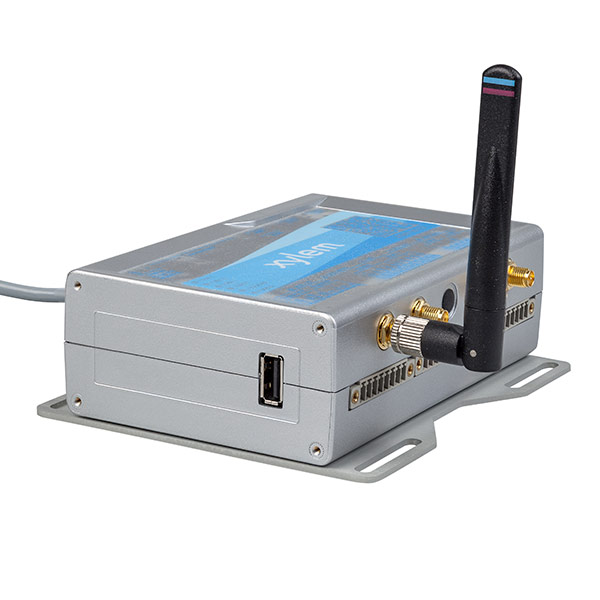
Gateway with REST API interface for the allocation of data records. Suitable for the parameters pH, ORP, conductivity and dissolved oxygen of IDS wireless sensors.
- Safe, automated measurement data collection
- Manipulation-proof, GxP-compliant additional data (metadata)
- Future-proof data format (JSON)
The IDS Gate is a software interface (API) that can be used to integrate IDS wireless sensors into an existing network. Via the interface, measured data and meta data can be automatically transferred to a database system (e.g. LIMS) or a spreadsheet program (e.g. Microsoft Excel). Data is transmitted wirelessly via a barcode reader or the IDS wireless sensors. The IDS Gate provides the data in JSON format. JSON is a data format that ensures that the data can be read very easily both by machine evaluation systems, such as LIMS or Excel, and by humans. The data transfer is encrypted via HTTPS. For digital long-term archiving, the data can also be provided as PDF/A in addition to JSON. The browser-based visualization makes it possible to display data in real time on networked hardware such as smartphones, tablets or monitors, independent of operating systems.
Power supply and antenna for WiFi/BT in scope of supply.
More information in our News: Labor of the future
-
Interfaces
Ethernet
2x 10/100Mbps - RJ45
USB
3x Host 2.0 (noise and surge protected) - Type A
Radio transmission
Wi-Fi
WI-FI a/b/g/n,
Bluetooth
BLE 4.2
Antenna (external)
2x RP-SMA Wi-Fi/BT
Clock
Real-time clock
Yes (user settable)
Power supply
Input
6-36VDC, transient protected
Consumption
2 W typical (15 W Max.)
Environmental conditions
Operation temperature
- 40 to +70 °C
Storage temperature
- 40 to +85 °C
Relative humidity
5 to 95 % (non-condensing) at 40 °C
Certificates
Compliance
CE
Safety
EN 62368-1: 2014 + A11: 2017
Environment
RoHS3
Protection class
IP30
Mechanical Design
Housing
Material: ABS
Dimensions
ca. 139 x 90 x 45 mm (W x D x H)
ca. 139 x 100 x 45 mm (W x D x H) (including antenna connectors)
Weight
210 g (without DIN rail mounting clip / holder)
Battery Type
BR1225 Lithium button cell
Case Studies
Municipal Wastewater Treatment · WTW — Stock Configuration Case
Customer Profile
The typical setting in Municipal Wastewater Treatment is the inlet, biological and outlet stages of a municipal plant. The measuring point is WTW; the focus is covering online and laboratory water analysis with WTW instruments.
Key Difficulties
Conditions are high solids and corrosive fractions, with large diurnal flow swings and, on top of that, effluent parameters drift and probes foul with sludge and biofilm, which a standard configuration cannot handle for long. The design therefore starts with selected by parameter set, range and digital sensor protocol.
Implementation
The scope ran through the stock channel: configuring from stock and delivered quickly. Technically it hinges on selected by parameter set, range and digital sensor protocol, and on these requirements: stable compliance with Grade 1A discharge limits and online data reporting.
Customer Benefit
In practice this means plug-and-play digital sensors that keep calibration when swapped, which cut the workload on the site maintenance team.
Food & Beverage · WTW — Stock Configuration Case
Project Background
The project covers dosing, pasteurising, filling and CIP stages. The work centres on WTW and the core task is covering online and laboratory water analysis with WTW instruments.
Operating Challenges
The medium and duty are characterised by syrups, dairy and beverages that scale easily, under strict hygienic requirements, and frequent cleaning demands instruments that withstand hot CIP/SIP caustic cycles. So WTW cannot be specified generically — it calls for selected by parameter set, range and digital sensor protocol.
Solution
The Ainstru engineering team worked through the stock channel: configuring from stock and delivered quickly. The configuration involves selected by parameter set, range and digital sensor protocol, with these requirements in view: food-safety and hygienic design per 3-A / EHEDG.
Results
Since start-up the system has run steadily; the practical result is plug-and-play digital sensors that keep calibration when swapped.
Chemical & Pharmaceutical · WTW — Stock Configuration Case
Project Overview
The site is reactors, metering vessels and finished-product tanks. The customer wanted WTW properly configured on the existing plant, with the aim of covering online and laboratory water analysis with WTW instruments.
Technical Challenges
What actually causes trouble is highly corrosive media with solvents and crystallisation, partly in explosive atmospheres, and corrosion plus Ex protection shortens instrument life and makes downtime costly. All of this means the WTW configuration has to involve selected by parameter set, range and digital sensor protocol.
Configuration
Supply and installation were organised through the stock channel: configuring from stock and delivered quickly. On site this meant selected by parameter set, range and digital sensor protocol, checked line by line against: Ex certification and GMP traceability of records.
Performance
After commissioning the outcome is plug-and-play digital sensors that keep calibration when swapped, and the readings are now used for process tuning.
Power & Energy · WTW — Stock Configuration Case
Site Conditions
This is a Power & Energy customer whose plant is at boiler feedwater, turbine condensate and FGD/DeNOx systems. The main task was covering online and laboratory water analysis with WTW instruments.
The Problem
The difficulty lies in high temperature and pressure with both steam and saline water; at the same time drift under high temperature and pressure, with very costly unplanned outages. Specification therefore means selected by parameter set, range and digital sensor protocol.
What We Did
We took a stock channel approach — configuring from stock and delivered quickly. Delivery was built around selected by parameter set, range and digital sensor protocol, with point-by-point checks on: compliance with power-industry codes and unit availability targets.
Operating Outcome
In service the system performs as intended — plug-and-play digital sensors that keep calibration when swapped, with routine maintenance falling noticeably.


