
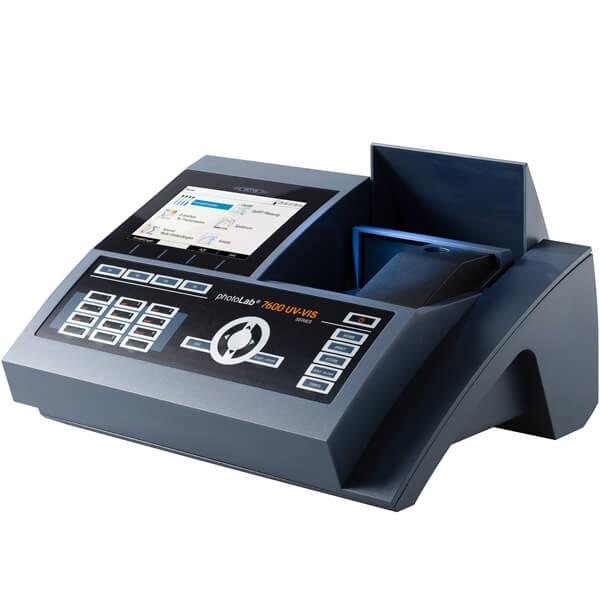
photoLab 7600 UV-VIS
Innovative and well-proven - Optical reagent-free (OptRF) and routine analysis!
The spectrophotometer photoLab® 7600 UV-VIS offers the universal use from well-proven routine analysis to spectral analysis with pioneering procedure OptRF for reagent-free measurement of COD, Nitrate and Nitrite. Furthermore, important parameters such as UVT and SAC as well as comprehensive color measurement are supported. Being light-weighted and optionally powered by standard car battery, photoLab® 7600 UV-VIS can be operated On-site easily.
- OptRF for standard parameters COD, NO3, NO2 in the outlet of sewage plants
- Menu-guided operation
- Multi-step AQA
- Application support from chlorophyll to wine
- Comprehensive programming opportunities
The future has arrived: Optical reagent-free measurement of COD, nitrate and nitrite (OptRF)
- Faster than the fastest digestion
- No costs, as no reagents or chemicals required
- Check of measurement range
- Environmentally friendly and no health hazards
COD, nitrate and nitrite
For the standard parameters COD, nitrate and nitrite, a spectrum in the UV range is evaluated by means of complex algorithms which are based on reference spectra. The result is put out directly as concentration reading, without the use of reagents. No potassium dichromate, no digestion - for quick testing. The composition of the water (matrix) is important for this value determination, since water is not equal to water.
OptRF
The OptRF-methods are currently being developed for sewage plant outlets. They can be optimized for the respective municipal waste water matrix by user calibration via reference values performed with standard procedures like test kits. Depending on the composition of surface waters, the methods can be used here as well after testing and verifying with reference procedures.
OptRF: How does it work? Can I use it? What do I have to consider? Have a look into our OptRF testing procedure.
UVT and SAC
For the UV-Disinfection as well as for monitoring of organic pollution these two parameters constantly gain importance: 5 programs with and without turbidity correction are offered. You will find all important information about SAC in the following article as part of the photometry dictionary: "SAC is not equal to SAC".
Well-proven routine analysis and wide-ranging application support
Simple measuring: photoLab® 7600 UV-VIS from 190 – 1100 nm supports the fastest and affordable routine analytics by using barcoded test kits and round and rectangular cuvettes just like the VIS version photoLab® 7100. More than 250 methods are available for water analytics, galvanics and general lab analytics.
Environmental parameters such as chlorophyll and application procedures for the food and beverage industry are supported by programmed methods and comprehensive programming options. With ist multi-wavelength, spectral and kinetics measurements this meter is suitable for mixed applications as well as research.
photoLab® color: Color measurement instead of color perception
The optional PC software photoLab® color + Data spectral offer comprehensive color measurement and convenient data management.
photoLab® Data spectral
The optional photoLab® Data spectral offers a GLP-compliant and convenient PC-interface to export, store and transfer data.
-
Wavelength Range 190 - 1100 nm Optics Monochromator with Grating and step motor / reference beam Lamp Wolfram-Halogen Display Farbdisplay 7" backlit Bandwidth 4 nm Measurement Concentration, Absorbance, % Transmission, Kinetics and Spectra in Abs or %Transmission, Multiwavelengths and multistep readings Scan speed 700-2000 nm/min, Scans in 1, 2, 5, 10 nm steps of wavelength range Wavelength accuracy/reproduceability ± 1 nm / < 0,5 nm Photometric accuracy/reproduceability - 0,003 E for E < 0,600; 0,5% of values for 0,600 < E < 2,000 Photometric linearity < 1 % for A ≤ 2.000 in the range 340 ... 900 nm Straylight < 0,1 %T at 220 nm with NaI, < 0.05 % transmission at 340 and 408 nm with cut-off filter Barcode Automatic method recognition including measurement range for all cuvette Cuvette 16 mm round, rectangular 10 mm, 20 mm, 50 mm with automatic cell detection for automatic measurement range setting Data storage 5000 meausrement values, spectra and kinetics approx. 40 MB => 500 spectra (300-900 nm) and 400 kinetics with 150 measurement values, Methods and Profiles > 250 pre-programmed methods, 1000 user-defined methods, profiles for kinetics and spectra, comprehensive programming options Interface / Update 1 USB-A, 1 USB-B, 1 Ethernet / Update via Internet and USB-Stick IP Class IP 30 including drainage in optical compartment Power Supply Universal power supply, optional supply via standard adaptor cable for car batteries Temperature Range Operation: +10°C bis +35°C, Storage: -25°C bis +65°C Weight / Dimensions approx. 4,5 kg / 404 x 197 x 314 (BxHxT) Accessories PC software photoLab® Data spectral+photoLab® color, field case, checking tools for AQA
Case Studies
Municipal Wastewater Treatment · WTW — Stock Configuration Case
Customer Profile
The typical setting in Municipal Wastewater Treatment is the inlet, biological and outlet stages of a municipal plant. The measuring point is WTW; the focus is covering online and laboratory water analysis with WTW instruments.
Key Difficulties
Conditions are high solids and corrosive fractions, with large diurnal flow swings and, on top of that, effluent parameters drift and probes foul with sludge and biofilm, which a standard configuration cannot handle for long. The design therefore starts with selected by parameter set, range and digital sensor protocol.
Implementation
The scope ran through the stock channel: configuring from stock and delivered quickly. Technically it hinges on selected by parameter set, range and digital sensor protocol, and on these requirements: stable compliance with Grade 1A discharge limits and online data reporting.
Customer Benefit
In practice this means plug-and-play digital sensors that keep calibration when swapped, which cut the workload on the site maintenance team.
Food & Beverage · WTW — Stock Configuration Case
Project Background
The project covers dosing, pasteurising, filling and CIP stages. The work centres on WTW and the core task is covering online and laboratory water analysis with WTW instruments.
Operating Challenges
The medium and duty are characterised by syrups, dairy and beverages that scale easily, under strict hygienic requirements, and frequent cleaning demands instruments that withstand hot CIP/SIP caustic cycles. So WTW cannot be specified generically — it calls for selected by parameter set, range and digital sensor protocol.
Solution
The Ainstru engineering team worked through the stock channel: configuring from stock and delivered quickly. The configuration involves selected by parameter set, range and digital sensor protocol, with these requirements in view: food-safety and hygienic design per 3-A / EHEDG.
Results
Since start-up the system has run steadily; the practical result is plug-and-play digital sensors that keep calibration when swapped.
Chemical & Pharmaceutical · WTW — Stock Configuration Case
Project Overview
The site is reactors, metering vessels and finished-product tanks. The customer wanted WTW properly configured on the existing plant, with the aim of covering online and laboratory water analysis with WTW instruments.
Technical Challenges
What actually causes trouble is highly corrosive media with solvents and crystallisation, partly in explosive atmospheres, and corrosion plus Ex protection shortens instrument life and makes downtime costly. All of this means the WTW configuration has to involve selected by parameter set, range and digital sensor protocol.
Configuration
Supply and installation were organised through the stock channel: configuring from stock and delivered quickly. On site this meant selected by parameter set, range and digital sensor protocol, checked line by line against: Ex certification and GMP traceability of records.
Performance
After commissioning the outcome is plug-and-play digital sensors that keep calibration when swapped, and the readings are now used for process tuning.
Power & Energy · WTW — Stock Configuration Case
Site Conditions
This is a Power & Energy customer whose plant is at boiler feedwater, turbine condensate and FGD/DeNOx systems. The main task was covering online and laboratory water analysis with WTW instruments.
The Problem
The difficulty lies in high temperature and pressure with both steam and saline water; at the same time drift under high temperature and pressure, with very costly unplanned outages. Specification therefore means selected by parameter set, range and digital sensor protocol.
What We Did
We took a stock channel approach — configuring from stock and delivered quickly. Delivery was built around selected by parameter set, range and digital sensor protocol, with point-by-point checks on: compliance with power-industry codes and unit availability targets.
Operating Outcome
In service the system performs as intended — plug-and-play digital sensors that keep calibration when swapped, with routine maintenance falling noticeably.


