
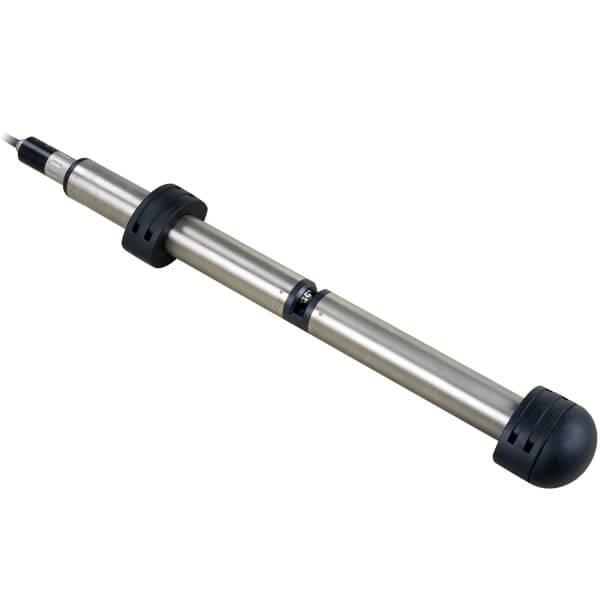
Continuous color measurement including nitrate, carbons and total suspended solids.
Continuous color measurement in acc. to APHA Hazen 2120 and DIN EN ISO 7887:
- Reliable and high accuracy by turbidity compensation
- All in one – Color, COD, NO3, TSS
- Robust materials such as Titanium and Peek
- Minimal maintenance effort by integrated ultrasonic cleaning
ColorVis 705 IQ:
Spectral UV-VIS sensor to measure color in wastewater, incl. integrated ultrasonic cleaning; available wavelengths (selectable): 340 nm, 350 nm, 390 nm, 410 nm, 445 nm, 455 nm, 465 nm; including turbidity compensation
CarboVis® 705 IQ TS Co:
Like ColorVis 705, including color parameters (COD, BOD, DOC, TOC, SAC, UVT) and total suspended solids
NiCaVis® 705 IQ TS Co:
Like ColorVis 705, including nitrate, carbon parameters (COD, BOD, DOC, TOC, SAC, UVT) and total suspended solids
NiCaVis® 705 IQ SF Co:
Like NiCaVis® 705 IQ TS Co, without TS for surface waters.
view product detail page
-
Model ColorVis 705 IQ CarboVis® 705 IQ TS Co NiCaVis® 705 IQ TS Co Order No. 481067 481065 481066 Measuring method Absorbance measurment (at specific wavelentgh) Spectral measurement in the UV-VIS
range of 200-720 nmMeasuring gap
(optical layer thickness)5 mm Application (optimized for) Municipal wastewater: Effluent Available parameters Color
Hazen 340
Hazen 350
Hazen 390
Hazen 445
Hazen 455
Hazen 465
ISO 410Color
Hazen 340
Hazen 350
Hazen 390
Hazen 445
Hazen 455
Hazen 465
ISO 410Color
Hazen 340
Hazen 350
Hazen 390
Hazen 445
Hazen 455
Hazen 465
ISO 410Carbons Carbons TSS TSS Nitrate Turbidity comp. Integrated, selectable Certifications CE Protection class IP68 detailed technical data incl. measuring range see data sheet D2.27
Case Studies
Municipal Wastewater Treatment · WTW — Stock Configuration Case
Customer Profile
The typical setting in Municipal Wastewater Treatment is the inlet, biological and outlet stages of a municipal plant. The measuring point is WTW; the focus is covering online and laboratory water analysis with WTW instruments.
Key Difficulties
Conditions are high solids and corrosive fractions, with large diurnal flow swings and, on top of that, effluent parameters drift and probes foul with sludge and biofilm, which a standard configuration cannot handle for long. The design therefore starts with selected by parameter set, range and digital sensor protocol.
Implementation
The scope ran through the stock channel: configuring from stock and delivered quickly. Technically it hinges on selected by parameter set, range and digital sensor protocol, and on these requirements: stable compliance with Grade 1A discharge limits and online data reporting.
Customer Benefit
In practice this means plug-and-play digital sensors that keep calibration when swapped, which cut the workload on the site maintenance team.
Food & Beverage · WTW — Stock Configuration Case
Project Background
The project covers dosing, pasteurising, filling and CIP stages. The work centres on WTW and the core task is covering online and laboratory water analysis with WTW instruments.
Operating Challenges
The medium and duty are characterised by syrups, dairy and beverages that scale easily, under strict hygienic requirements, and frequent cleaning demands instruments that withstand hot CIP/SIP caustic cycles. So WTW cannot be specified generically — it calls for selected by parameter set, range and digital sensor protocol.
Solution
The Ainstru engineering team worked through the stock channel: configuring from stock and delivered quickly. The configuration involves selected by parameter set, range and digital sensor protocol, with these requirements in view: food-safety and hygienic design per 3-A / EHEDG.
Results
Since start-up the system has run steadily; the practical result is plug-and-play digital sensors that keep calibration when swapped.
Chemical & Pharmaceutical · WTW — Stock Configuration Case
Project Overview
The site is reactors, metering vessels and finished-product tanks. The customer wanted WTW properly configured on the existing plant, with the aim of covering online and laboratory water analysis with WTW instruments.
Technical Challenges
What actually causes trouble is highly corrosive media with solvents and crystallisation, partly in explosive atmospheres, and corrosion plus Ex protection shortens instrument life and makes downtime costly. All of this means the WTW configuration has to involve selected by parameter set, range and digital sensor protocol.
Configuration
Supply and installation were organised through the stock channel: configuring from stock and delivered quickly. On site this meant selected by parameter set, range and digital sensor protocol, checked line by line against: Ex certification and GMP traceability of records.
Performance
After commissioning the outcome is plug-and-play digital sensors that keep calibration when swapped, and the readings are now used for process tuning.
Power & Energy · WTW — Stock Configuration Case
Site Conditions
This is a Power & Energy customer whose plant is at boiler feedwater, turbine condensate and FGD/DeNOx systems. The main task was covering online and laboratory water analysis with WTW instruments.
The Problem
The difficulty lies in high temperature and pressure with both steam and saline water; at the same time drift under high temperature and pressure, with very costly unplanned outages. Specification therefore means selected by parameter set, range and digital sensor protocol.
What We Did
We took a stock channel approach — configuring from stock and delivered quickly. Delivery was built around selected by parameter set, range and digital sensor protocol, with point-by-point checks on: compliance with power-industry codes and unit availability targets.
Operating Outcome
In service the system performs as intended — plug-and-play digital sensors that keep calibration when swapped, with routine maintenance falling noticeably.


