
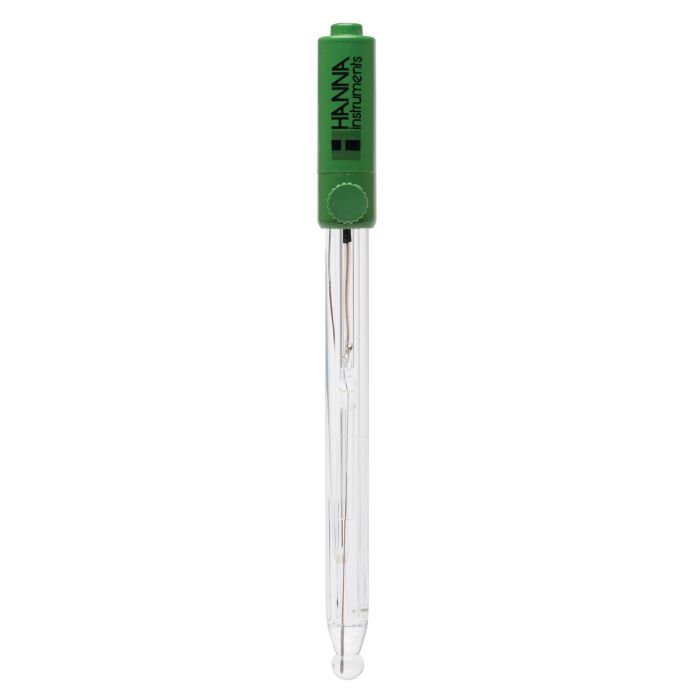
Electrodo de pH combinado de vidrio rellenable
-
HI1131P Refillable Single Junction Glass Combination pH Electrode Measuring range: 0 to 13 pH, Sample temperature range: 0 to 100°C (32 to 212°F), Sample pressure ≤0.1 bar; BNC+PIN connector
-
Suitable for routine laboratory, beer and other sample measurements
-
When using a new electrode, first remove the protective cap from the top and inspect the entire electrode. If salt crystals are found on the electrode head and inside the protective cap due to evaporation of the internal electrolyte through the junction, this does not affect normal use of the electrode and indicates that the electrode junction is functioning properly; simply rinse it off with clean water. During transport, air bubbles may form inside the glass bulb at the electrode head. In this case, gently shake the electrode as you would a common mercury thermometer to remove the bubbles. If the glass sensing membrane or junction of the electrode is relatively dry, soak the electrode in HI70300 electrode storage solution for at least 1 hour to keep the dry glass sensing membrane and junction moist; frequent soaking is beneficial for the electrode.
HI1131P features high-temperature (HT) glass, spherical bulb, glass body, single ceramic frit, double junction, refillable with 3.5M KCl.
High-Temperature Glass Formulation
Measuring pH at very high temperatures is harmful to sensitive glass bulbs and shortens their service life. pH electrodes with general-purpose (GP) glass have a resistance of 100 megohms at 25°C, while HT glass has a resistance of approximately 400 megohms at 25°C. Since HI1131P is used at high temperatures, the resistance decreases to approach that of GP glass. HI1131P is suitable for sample measurement ranges of 0 to 100°C.
Spherical Glass Tip
Spherical bulbs are used for general purposes. Other shapes include conical for penetration and flat for surface measurements.
Glass Body
A glass body is ideal for laboratory use. The glass resists many harsh chemicals and is easy to clean. The glass body also allows heat to be transferred quickly to the internal reference electrolyte. The mV generated by the reference cell is temperature-dependent. The faster the electrode reaches equilibrium, the more stable the reference potential.
Single Ceramic Double Junction Reference
HI1131P features a double junction design. pH electrodes are available with either single or double junctions. For a complete explanation of the differences, please refer to the section below. The junction, also called a salt bridge, is an essential component of the circuit. Ion movement must flow through the junction to obtain stable readings. The outer reference has a single ceramic frit. Ceramic is a porous material that fuses easily with the glass body and has a similar coefficient of expansion. The flow rate of a single ceramic junction is 15-20 μL/hour. Other junction types have higher flow rates and are made from different materials.
Refillable
HI1131P is a refillable probe. Since it is a double junction pH electrode, the filling solution is HI7082 3.5M KCl. This solution does not contain any silver, unlike single junction electrodes. The absence of silver prevents any silver precipitate from forming at the junction and clogging it. A clogged junction will cause reading drift and instability.
BNC + Pin Connector
-
HI1131P uses a BNC and pin connector. The BNC connector is universal, as it can be used with any pH meter that has a female BNC probe input. The pin connector is used to enable the CAL Check function on the following benchtop pH meters: HI122, HI123, HI221, HI222, HI223, HI2221, HI2222 and HI2223.
-
Note: Do not use distilled or deionized water to store or soak the electrode, as this will cause the electrode sensor to fail
| Order No. | HI1131P |
| Name | Refillable Combination pH Electrode with BNC + Pin Connector - HI1131P |
| Quote Required | Yes |
| Measuring range | pH |
| Reference cell type | Double, Ag/AgCl |
| Junction type/flow rate | Ceramic, single / 15-20 μL/h |
| Refill electrolyte | 3.5M KCl |
| Body material | Glass |
| Tip/Shape | Spherical (diameter) |
| Matching pin | No |
| Max pressure | 0.1 bar |
| Operating temperature range | 0 to 100°C (32 to 212°F) - HT |
| Temp. sensor | No |
| Cable | Coaxial; 1 m |
| Connector type | BNC + Pin |
| Amplifier | No |
| Recommended use | General purpose, high temperature, general laboratory |
Casos de servicio
Tratamiento de Aguas Residuales Municipales — Hanna: caso de configuración desde stock
Resumen del proyecto
La instalación está en las etapas de entrada, biológica y salida de una planta municipal. El cliente quería configurar bien Hanna en la planta existente, con el objetivo de análisis portátil y de laboratorio con instrumentos Hanna.
Retos técnicos
Lo que realmente da problemas es alto contenido de sólidos y componentes corrosivos, con grandes variaciones diarias de caudal, y los parámetros del efluente oscilan y las sondas se ensucian con lodos y biopelícula. Todo ello implica que la configuración de Hanna deba incluir selección por parámetros, precisión y portabilidad.
Configuración
El suministro y la instalación se organizaron por la vía de stock: configurar desde stock y entregado con rapidez. En planta esto supuso selección por parámetros, precisión y portabilidad; se revisó línea a línea: cumplimiento estable del nivel 1A y reporte de datos en línea.
Comportamiento
Tras la puesta en marcha el resultado es resultados in situ, con menos verificaciones de laboratorio, y las lecturas se usan ya para ajustar el proceso.
Alimentación y Bebidas — Hanna: caso de configuración desde stock
Situación en planta
Se trata de un cliente del sector Alimentación y Bebidas cuya planta está en las etapas de dosificación, pasteurización, llenado y limpieza CIP. La tarea principal era análisis portátil y de laboratorio con instrumentos Hanna.
El problema
La dificultad está en jarabes, lácteos y bebidas proclives a incrustaciones, con estrictos requisitos higiénicos; a la vez, las limpiezas frecuentes exigen instrumentos resistentes a ciclos CIP/SIP con sosa caliente. Por eso la especificación implica selección por parámetros, precisión y portabilidad.
Qué hicimos
Adoptamos un enfoque de stock: configurar desde stock y entregado con rapidez. La entrega se construyó en torno a selección por parámetros, precisión y portabilidad; se verificó punto por punto: requisitos de seguridad alimentaria y diseño higiénico 3-A / EHEDG.
Resultado operativo
En servicio el sistema responde a lo previsto: resultados in situ, con menos verificaciones de laboratorio, con un mantenimiento rutinario notablemente menor.
Química y Farmacéutica — Hanna: caso de configuración desde stock
Contexto de aplicación
reactores, vasijas de dosificación y tanques de producto terminado es un servicio típico de Química y Farmacéutica. El proyecto partió de Hanna, centrándose en análisis portátil y de laboratorio con instrumentos Hanna.
Limitaciones del proceso
la corrosión y la protección Ex acortan la vida útil y encarecen las paradas, y medios muy corrosivos con disolventes y cristalización, en parte en atmósferas explosivas no hace sino acentuarlo. Por eso la especificación de Hanna debe cubrir selección por parámetros, precisión y portabilidad.
Enfoque de suministro
La entrega se gestionó como stock: configurar desde stock y entregado con rapidez. La ejecución se centró en selección por parámetros, precisión y portabilidad, junto con certificación Ex y trazabilidad de datos según GMP.
Resultados en campo
La operación evidencia el beneficio: resultados in situ, con menos verificaciones de laboratorio, con una confianza claramente mayor en este punto de medición.
Energía y Electricidad — Hanna: caso de configuración desde stock
Perfil del cliente
El entorno típico en Energía y Electricidad es agua de alimentación, condensado de turbina y sistemas de desulfuración/DeNOx. El punto de medición es Hanna; el foco es análisis portátil y de laboratorio con instrumentos Hanna.
Dificultades clave
Las condiciones son alta temperatura y presión, con vapor y agua salina y, encima, deriva a alta temperatura y presión, con paradas no programadas muy costosas, algo que una configuración estándar no soporta mucho tiempo. El diseño parte de selección por parámetros, precisión y portabilidad.
Implementación
El alcance se canalizó por la vía de stock: configurar desde stock y entregado con rapidez. Técnicamente se apoya en selección por parámetros, precisión y portabilidad, y en estos requisitos: cumplimiento de normativas del sector y objetivos de disponibilidad.
Beneficio para el cliente
En la práctica esto significa resultados in situ, con menos verificaciones de laboratorio, lo que redujo la carga del equipo de mantenimiento.
Recomendados similares
 HANNA Instruments
Medidor de conductividad portátil de rangos múltiples
 HANNA Instruments
Fotómetro portátil de nitrógeno amoniacal de rango bajo
 HANNA Instruments
Turbidímetro portátil de rangos múltiples
 HANNA Instruments
Medidor de salinidad para acuarios de agua salada
 HANNA Instruments
Analizador portátil de color de miel
HANNA InstrumentsFotómetro portátil de cloro libre
 HANNA Instruments
Fotómetro portátil de cloro residual y total
 HANNA Instruments