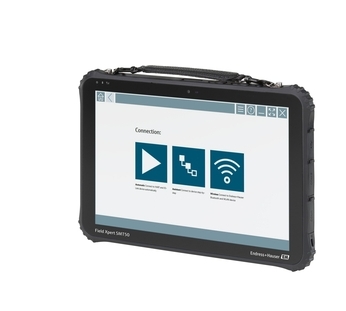
The Field Xpert SMT50 is a universal tablet PC for device configuration that supports multiple communication protocols and Endress+Hauser service protocols and can connect to Endress+Hauser field devices equipped with Bluetooth. Connections to field devices can be established directly via a suitable interface, for example a modem (point-to-point) or a bus system (point-to-bus); wireless connections (WLAN/Bluetooth interface) are also possible. The Field Xpert software is fast, convenient and intuitive to operate. More than 3000 pre-installed devices and communication drivers are stored in the device library.
Advantages
The tablet PC is robust, equipped with a 12" large display and offers a battery life of up to 8 hours.
-
Touch-operated device configuration software that optimizes plant asset management.
-
Direct connection to the Endress+Hauser IIoT ecosystem Netilion.
-
Pre-installed device driver library supporting all important industrial protocols.
-
Automatic hardware detection function can be started with a single click for fast device connection. Online application software and DTM file/driver upgrade services provide new functions and high security.
-
Equipped with heartbeat self-verification function, outputs PDF verification documents
-
Connects to Endress+Hauser devices equipped with Bluetooth and WLAN interfaces, particularly suitable for hard-to-operate instruments
Field of application
The Field Xpert SMT50 tablet PC is used for device configuration, enabling mobile plant asset management in hazardous and non-hazardous areas. It can be used for device commissioning and device maintenance. It manages Endress+Hauser and third-party devices via digital communication interfaces and archives all operations. The SMT50 is a complete solution. With a built-in driver library for pre-installed devices and convenient touch operation, it provides full life-cycle management services for field devices.
Configurator / Comparison
Accessories/Spare parts
Source:Endress+Hauserpublic information from the website
Case Studies
Municipal Wastewater Treatment · Process Measuring and Control Instrument — Application Case
Application Context
the inlet, biological and outlet stages of a municipal plant is a typical Municipal Wastewater Treatment duty. The project started from Process Measuring and Control Instrument, focusing on measurement, control and recording for process loops.
Process Constraints
effluent parameters drift and probes foul with sludge and biofilm, and high solids and corrosive fractions, with large diurnal flow swings only amplify it. The Process Measuring and Control Instrument specification must therefore cover configured by input type, loop count and communication.
Delivery Approach
Delivery was handled as the system components range — supplying as a full cabinet and signal-chain configuration. Execution centred on configured by input type, loop count and communication, together with stable compliance with Grade 1A discharge limits and online data reporting.
Field Results
Operation shows the benefit clearly — configured on site, cutting back-and-forth during system commissioning, with confidence in this measuring point improving markedly.
Municipal Wastewater Treatment · data manager — Application Case
Site Conditions
This is a Municipal Wastewater Treatment customer whose plant is at the inlet, biological and outlet stages of a municipal plant. The main task was centralised data acquisition, storage and forwarding to management platforms.
The Problem
The difficulty lies in high solids and corrosive fractions, with large diurnal flow swings; at the same time effluent parameters drift and probes foul with sludge and biofilm. Specification therefore means selected by channel count, storage depth and forwarding protocol.
What We Did
We took a system components range approach — supplying as a full cabinet and signal-chain configuration. Delivery was built around selected by channel count, storage depth and forwarding protocol, with point-by-point checks on: stable compliance with Grade 1A discharge limits and online data reporting.
Operating Outcome
In service the system performs as intended — automatic backfill after outages, greatly improving data completeness, with routine maintenance falling noticeably.
Municipal Wastewater Treatment · Power supplies and safety barriers — Application Case
Project Overview
The site is the inlet, biological and outlet stages of a municipal plant. The customer wanted Power supplies and safety barriers properly configured on the existing plant, with the aim of supplying power and intrinsic-safety isolation to field instruments.
Technical Challenges
What actually causes trouble is high solids and corrosive fractions, with large diurnal flow swings, and effluent parameters drift and probes foul with sludge and biofilm. All of this means the Power supplies and safety barriers configuration has to involve selected by loop count, Ex rating and redundancy needs.
Configuration
Supply and installation were organised through the system components range: supplying as a full cabinet and signal-chain configuration. On site this meant selected by loop count, Ex rating and redundancy needs, checked line by line against: stable compliance with Grade 1A discharge limits and online data reporting.
Performance
After commissioning the outcome is compliant IS loops, lowering live-work risk during maintenance, and the readings are now used for process tuning.
Municipal Wastewater Treatment · Gateways and modems — Application Case
Project Background
The project covers the inlet, biological and outlet stages of a municipal plant. The work centres on Gateways and modems and the core task is converting field data into remote transmission channels.
Operating Challenges
The medium and duty are characterised by high solids and corrosive fractions, with large diurnal flow swings, and effluent parameters drift and probes foul with sludge and biofilm. So Gateways and modems cannot be specified generically — it calls for configured by protocol, tag count and carrier network conditions.
Solution
The Ainstru engineering team worked through the system components range: supplying as a full cabinet and signal-chain configuration. The configuration involves configured by protocol, tag count and carrier network conditions, with these requirements in view: stable compliance with Grade 1A discharge limits and online data reporting.
Results
Since start-up the system has run steadily; the practical result is remote sites can report back, making unattended operation possible.