
-
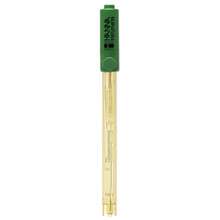
HI1332P is a PEI body, double junction pH electrode with a BNC and pin connector. The pin connector is used to enable the CAL Check function of the HI2221, HI2222, and HI2223 benchtop meters. The electrode has a single ceramic junction in the outer reference cell, and the pH sensing portion is made of general purpose glass and is protected by an extension of the durable PEI body. This design consideration is ideal for field applications and general purpose use.
-
Durable PEI body
-
Double junction design
-
Refillable electrode
-
Hanna Instruments offers a wide variety of pH electrodes that are designed for many different applications. The type of glass used for sensing pH, bulb shape, body material, type of junction, type of reference and electrolyte used are just some of the design considerations.
-
The HI1332P uses general purpose (GP) glass, spherical bulb, polyetherimide (PEI) body, single ceramic frit, and double junction.
General Purpose Glass Formulation
Measuring pH at very high temperatures is detrimental to the sensitive glass bulb and will shorten its life. A pH electrode with general purpose (GP) glass will have a resistance of 100 megohms at 25°C, while LT glass has a resistance of about 50 megohms at 25°C. As the glass temperature decreases in a sample, the resistance of LT glass will approach that of GP glass. If GP glass is used, the resistance will increase above the optimum range, resulting in increased impedance and ultimately affecting the measurement. The HI1332P is suitable for samples from 0 to 70°C.
Spherical Bulb
The spherical bulb is general purpose. Other tip shapes include conical for penetration and flat tip for surface measurements.
PEI Body
The HI1332P body is composed of polyetherimide (PEI) resin. The PEI body is suitable for a wide range of applications and excels in field measurements due to its durability. The shielding around the spherical glass tip minimizes breakage due to accidental bumping or dropping of the electrode. PEI plastic is a high quality plastic that is chemically resistant to many aggressive chemicals.
Double Junction Reference
A double junction electrode has an internal compartment surrounding the reference wire. Silver ions are present in the electrolyte of the internal compartment, which houses the Ag/AgCl reference wire; the electrolyte outside this compartment is silver free. The double junction design means that virtually no silver enters the sample from the electrode. This design allows for measurement in applications where silver ions in the sample are undesirable or where silver precipitates may form on the junction.
BNC+Pin Connector
-
The HI1332P uses a BNC+Pin connector. The BNC type connector is universal in that it can be used on any pH meter that has a female BNC probe input. The pin connector is used to enable the CAL Check function on the following benchtop pH meters; HI122, HI123, HI221, HI222, HI223, HI2221, HI2222, and HI2223.
-
Conventional electrodes are normally single junction. As shown in the figure above, these electrodes have only a single junction between the internal reference wire and the external solution. Under adverse conditions, such as high pressure, high temperature, high acidity or alkalinity solutions, the positive flow of electrolyte through the junction is often reversed, resulting in the sample solution entering the reference chamber. If left unchecked, the reference electrode may become contaminated, resulting in complete failure of the electrode. Another potential problem with single junction electrodes is junction clogging due to silver chloride (AgCl) precipitation. Silver easily precipitates in samples containing Tris buffer or heavy metals. When the electrolyte solution contacts the sample, some silver chloride will precipitate on the outer surface of the junction. The result is a drifting reading obtained from the sensor.
-
As the name implies, Hanna's double junction system has two junctions, as shown in the figure, only one of which is in contact with the sample. Under adverse conditions, the tendency for the sample to enter is evident. However, since the reference electrode system is physically separated from the intermediate electrolyte region, contamination of the electrode is minimized. Since the outer reference cell uses a “silver-free” fill solution, the double junction electrode also reduces the likelihood of junction clogging. Since silver is not present, no precipitate can form to clog the junction.
| Specification Name | Detail |
|---|---|
| SKU | HI1332P |
| Description | pH electrode |
| Reference | double, Ag/AgCl |
| Junction / Flow Rate | ceramic, single / 15-20 µL/h |
| Electrolyte | KCl 3.5M |
| Max Pressure | 0.1 bar |
| Range | pH: 0 to 13 |
| Recommended Operating Temperature | 0 to 70°C (32 to 158°F) - GP |
| Tip / Shape | spheric (dia: 7.5 mm) |
| Temperature Sensor | no |
| Amplifier | no |
| Body Material | PEI |
| Cable | coaxial; 1 m (3.3’) |
| Recommended Use | chemicals, field applications, quality control, aquariums |
| Connection | DIN |
Case Studies
Municipal Wastewater Treatment · Hanna — Stock Configuration Case
Project Overview
The site is the inlet, biological and outlet stages of a municipal plant. The customer wanted Hanna properly configured on the existing plant, with the aim of covering portable and laboratory water testing with Hanna instruments.
Technical Challenges
What actually causes trouble is high solids and corrosive fractions, with large diurnal flow swings, and effluent parameters drift and probes foul with sludge and biofilm. All of this means the Hanna configuration has to involve selected by parameter set, accuracy and field portability.
Configuration
Supply and installation were organised through the stock channel: configuring from stock and delivered quickly. On site this meant selected by parameter set, accuracy and field portability, checked line by line against: stable compliance with Grade 1A discharge limits and online data reporting.
Performance
After commissioning the outcome is results available on site, reducing lab re-checks, and the readings are now used for process tuning.
Food & Beverage · Hanna — Stock Configuration Case
Site Conditions
This is a Food & Beverage customer whose plant is at dosing, pasteurising, filling and CIP stages. The main task was covering portable and laboratory water testing with Hanna instruments.
The Problem
The difficulty lies in syrups, dairy and beverages that scale easily, under strict hygienic requirements; at the same time frequent cleaning demands instruments that withstand hot CIP/SIP caustic cycles. Specification therefore means selected by parameter set, accuracy and field portability.
What We Did
We took a stock channel approach — configuring from stock and delivered quickly. Delivery was built around selected by parameter set, accuracy and field portability, with point-by-point checks on: food-safety and hygienic design per 3-A / EHEDG.
Operating Outcome
In service the system performs as intended — results available on site, reducing lab re-checks, with routine maintenance falling noticeably.
Chemical & Pharmaceutical · Hanna — Stock Configuration Case
Application Context
reactors, metering vessels and finished-product tanks is a typical Chemical & Pharmaceutical duty. The project started from Hanna, focusing on covering portable and laboratory water testing with Hanna instruments.
Process Constraints
corrosion plus Ex protection shortens instrument life and makes downtime costly, and highly corrosive media with solvents and crystallisation, partly in explosive atmospheres only amplify it. The Hanna specification must therefore cover selected by parameter set, accuracy and field portability.
Delivery Approach
Delivery was handled as the stock channel — configuring from stock and delivered quickly. Execution centred on selected by parameter set, accuracy and field portability, together with Ex certification and GMP traceability of records.
Field Results
Operation shows the benefit clearly — results available on site, reducing lab re-checks, with confidence in this measuring point improving markedly.
Power & Energy · Hanna — Stock Configuration Case
Customer Profile
The typical setting in Power & Energy is boiler feedwater, turbine condensate and FGD/DeNOx systems. The measuring point is Hanna; the focus is covering portable and laboratory water testing with Hanna instruments.
Key Difficulties
Conditions are high temperature and pressure with both steam and saline water and, on top of that, drift under high temperature and pressure, with very costly unplanned outages, which a standard configuration cannot handle for long. The design therefore starts with selected by parameter set, accuracy and field portability.
Implementation
The scope ran through the stock channel: configuring from stock and delivered quickly. Technically it hinges on selected by parameter set, accuracy and field portability, and on these requirements: compliance with power-industry codes and unit availability targets.
Customer Benefit
In practice this means results available on site, reducing lab re-checks, which cut the workload on the site maintenance team.
Related Products
 HANNA Instruments
Portable multi-range conductivity meter
 HANNA Instruments
Low range ammonia nitrogen portable photometer
 HANNA Instruments
Portable multi-range turbidimeter
 HANNA Instruments
Saltwater aquarium salinity meter
 HANNA Instruments
Portable honey color analyzer
HANNA InstrumentsPortable free chlorine photometer
 HANNA Instruments
Portable free and total chlorine photometer
 HANNA Instruments