
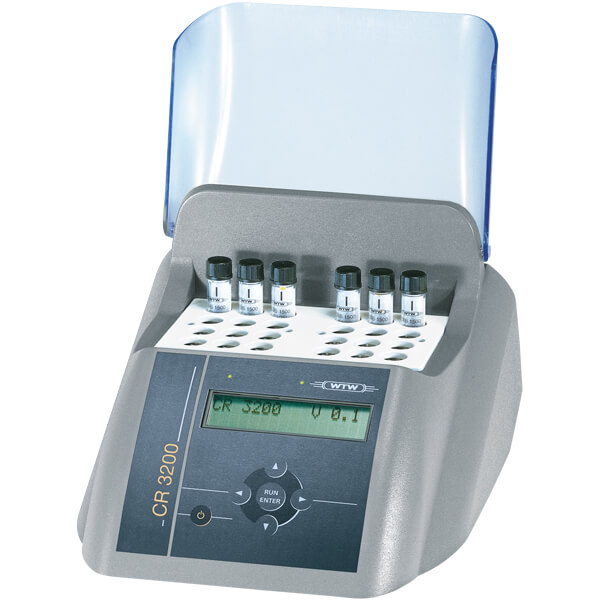
Two-zone programmable thermoreactor CR 3200
Product Overview
-
-
Digestions of 24 round cells with pre-programmed and user-defined programs
-
In total 24 round cells (16 mm) in two seperate heating blocks using the same program
-
8 stored programs for easy and fast operation including COD fast digestion
-
8 user-defined programs from room temperature/25-170°C with high temperature digestion
-
AQA/IQC with optional external temperature sensor for documentation
-
Programs for standard parameters COD including fast digestion (148°C, 20 min.), total nitrogen, total phosphorus, TOC and heavy metals of galvanizing with automatic heating and switch-off quick. User defined programs can be easily entered and stored from room temperature respectively 25-170°C to perform special digestions and thus allow high temperature digestion.
-
The very same program can be run for all vials at the same time; to perform two parallel digestion programs, the CR 4200 is the suitable choice. For the analytical quality assurance (AQA), the external temperature sensor TFK CR can be connected to the PC/printer instead of a round cell.
-
Programs for standard parameters
-
1: 148 °C for 120 minutes
-
2: 120 °C for 30 minutes
-
3: 120 °C for 60 minutes
-
4: 120 °C for 120 minutes
-
5: 100 °C for 60 minutes
-
6: 148 °C for 20 minutes
-
7: 150 °C for 120 minutes
-
8: 100 °C for 30 minutes
Reactor type Dry temperature control device with safety cover Cell shafts 2 x 12 cell shafts for reaction cells, diameter: 16 ± 0.2 mm Reaction time setting program settings or user-defined programs up to 180 min Temperature setting stored program, user-defined settings from room temperature up to 170°C Controlling accuracy ± 1 °C ± 1 digit Temperature stability ± 0.5 K Overtemperature protection 190 °C ± 5 °C Dimensions D x W x H: 312 x 255 x 185 mm Weight: 4 kg Output unidirectional RS232 interface with 2 banana sockets for external temperature sensor (article-# 250 100), printer, PC Power supply 115/230 VAC 50/60 Hz switchable via fuse setting
allowed voltage tolerance: ±15 % maximum power consumption: 560 W, Fuse 2x6.3 ATProtection Class IP 20 according to EN 60529 Ambient temperature Operation +5 °C to +40 °C Climatic class 2 according to VDI/VDE 3540 Relative humidity: Yearly mean: < 75 % 30 days /year: 95 % Other days: 85 % Light dew: yes Site altitude: max. 5000 m above sea level EMC EN 61326-1 FCC 47 CFR Part 15 Test certificates cETLus, CE Safety standards EN 61010-1 EN 61010-2-010 UL 61010-1 CAN/CSA C22.2#61010-1 CAN/CSA C22.2#61010-2-010 -
Case Studies
Municipal Wastewater Treatment · WTW — Stock Configuration Case
Customer Profile
The typical setting in Municipal Wastewater Treatment is the inlet, biological and outlet stages of a municipal plant. The measuring point is WTW; the focus is covering online and laboratory water analysis with WTW instruments.
Key Difficulties
Conditions are high solids and corrosive fractions, with large diurnal flow swings and, on top of that, effluent parameters drift and probes foul with sludge and biofilm, which a standard configuration cannot handle for long. The design therefore starts with selected by parameter set, range and digital sensor protocol.
Implementation
The scope ran through the stock channel: configuring from stock and delivered quickly. Technically it hinges on selected by parameter set, range and digital sensor protocol, and on these requirements: stable compliance with Grade 1A discharge limits and online data reporting.
Customer Benefit
In practice this means plug-and-play digital sensors that keep calibration when swapped, which cut the workload on the site maintenance team.
Food & Beverage · WTW — Stock Configuration Case
Project Background
The project covers dosing, pasteurising, filling and CIP stages. The work centres on WTW and the core task is covering online and laboratory water analysis with WTW instruments.
Operating Challenges
The medium and duty are characterised by syrups, dairy and beverages that scale easily, under strict hygienic requirements, and frequent cleaning demands instruments that withstand hot CIP/SIP caustic cycles. So WTW cannot be specified generically — it calls for selected by parameter set, range and digital sensor protocol.
Solution
The Ainstru engineering team worked through the stock channel: configuring from stock and delivered quickly. The configuration involves selected by parameter set, range and digital sensor protocol, with these requirements in view: food-safety and hygienic design per 3-A / EHEDG.
Results
Since start-up the system has run steadily; the practical result is plug-and-play digital sensors that keep calibration when swapped.
Chemical & Pharmaceutical · WTW — Stock Configuration Case
Project Overview
The site is reactors, metering vessels and finished-product tanks. The customer wanted WTW properly configured on the existing plant, with the aim of covering online and laboratory water analysis with WTW instruments.
Technical Challenges
What actually causes trouble is highly corrosive media with solvents and crystallisation, partly in explosive atmospheres, and corrosion plus Ex protection shortens instrument life and makes downtime costly. All of this means the WTW configuration has to involve selected by parameter set, range and digital sensor protocol.
Configuration
Supply and installation were organised through the stock channel: configuring from stock and delivered quickly. On site this meant selected by parameter set, range and digital sensor protocol, checked line by line against: Ex certification and GMP traceability of records.
Performance
After commissioning the outcome is plug-and-play digital sensors that keep calibration when swapped, and the readings are now used for process tuning.
Power & Energy · WTW — Stock Configuration Case
Site Conditions
This is a Power & Energy customer whose plant is at boiler feedwater, turbine condensate and FGD/DeNOx systems. The main task was covering online and laboratory water analysis with WTW instruments.
The Problem
The difficulty lies in high temperature and pressure with both steam and saline water; at the same time drift under high temperature and pressure, with very costly unplanned outages. Specification therefore means selected by parameter set, range and digital sensor protocol.
What We Did
We took a stock channel approach — configuring from stock and delivered quickly. Delivery was built around selected by parameter set, range and digital sensor protocol, with point-by-point checks on: compliance with power-industry codes and unit availability targets.
Operating Outcome
In service the system performs as intended — plug-and-play digital sensors that keep calibration when swapped, with routine maintenance falling noticeably.


