
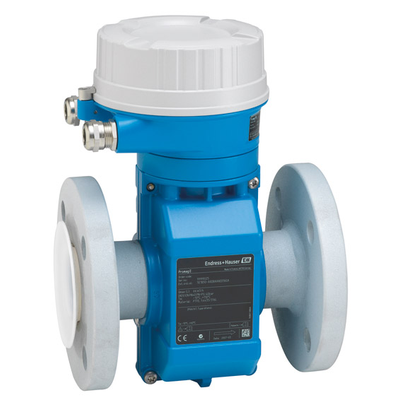
Technical Data
CompareLiquids
| Measuring Principle | Electromagnetic |
| Product headline | The economical flowmeter with an ultra-compact transmitter. Fully suitable for basic applications in the chemical and process industry. |
| Sensor features | Cost-effective sensor – ideal solution for basic requirements. Energy‐saving flow measurement – no pressure loss due to cross section constriction. Maintenance‐free – no moving parts. Nominal diameter: max. DN 600 (24"). Ex approvals for Zone 2. Liner made of PTFE. |
| Transmitter features | Space-saving transmitter – full functionality on the smallest footprint. Time-saving local operation without additional software and hardware – integrated web server. Integrated verification – Heartbeat Technology. Robust, ultra-compact transmitter housing. Local display available. |
| Nominal diameter range | DN 15 to 600 (½ to 24") |
| Wetted materials | Liner: PTFE Electrodes: 1.4435 (316L); Alloy C22, 2.4602 (UNS N06022); Tantalum |
| Measured variables | Volume flow, conductivity, mass flow |
| Max. measurement error | Volume flow (standard): ±0.5 % o.r. ± 1 mm/s (0.04 in/s) Volume flow (option): ±0.2 % o.r. ± 2 mm/s (0.08 in/s) |
| Measuring range | 4 dm³/min to 9600 m³/h (1 to 44 000 gal/min) |
| Max. process pressure | PN 40, Class 150, 20K |
| Medium temperature range | –10 to +110 °C (+14 to +230 °F) |
| Ambient temperature range | –10 to +60 °C (+14 to +140 °F) |
| Sensor housing material | DN 15 to 300 (½ to 12"): AlSi10Mg, coated DN 350 to 600 (14 to 24"): Carbon steel with protective varnish |
| Transmitter housing material | AlSi10Mg, coated |
| Degree of protection | IP67, type 4X enclosure |
| Display/Operation | 4‐line backlit display available (no local operation) Configuration via web browser and operating tools possible |
| Outputs | 4‐20 mA HART (active) Pulse/frequency/switch output (passive) |
| Inputs | None |
| Digital communication | HART, PROFIBUS DP, Modbus RS485, EtherNet/IP, PROFINET |
| Power supply | DC 20 to 30 V |
| Hazardous area approvals | ATEX, IECEx, cCSAus, INMETRO, EAC |
| Product safety | CE, C-Tick |
| Metrological approvals and certificates | Calibration performed on accredited calibration facilities (acc. to ISO/IEC 17025) Heartbeat Technology complies with the requirements for measurement traceability according to ISO 9001:2015 – Section 7.1.5.2 a (TÜV SÜD attestation) |
| Pressure approvals and certificates | PED |
| Material certificates | 3.1 material |
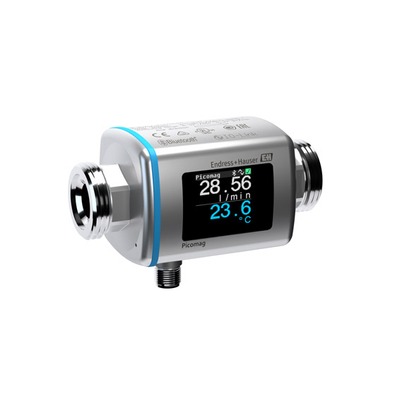
Promag E is the standard electromagnetic flow sensor for the chemical industry, offering customers the most economical solution. Combined with the smallest transmitter housing currently available, all functions are realized in the smallest space. Designed for applications in confined spaces, Promag E 100 is the optimum choice for system integrators, skid builders and equipment manufacturers.
Promag E is a reliable, economical sensor for measuring conductive liquids and is suitable for a wide range of basic applications in the chemical industry. Promag E 100 is equipped with an ultra-compact transmitter that is small in size yet fully functional, enabling seamless system integration, making it the first choice for skid builders, equipment manufacturers and system integrators. Heartbeat Technology always ensures compliance and process safety.
Advantages
Economical sensor: the ideal solution for basic requirements
Energy-saving flow measurement: no pressure loss due to pipe cross-section restrictions
Maintenance-free – no moving parts
Small transmitter – all functions in the smallest space
Time-saving on-site operation without additional software and hardware – built-in web server
Self-testing and self-verification – Heartbeat Technology
Application
The bidirectional measuring principle is not affected by pressure, density, temperature or viscosity
Fully suitable for basic applications in the chemical and process industries
Device characteristics
Nominal diameter: max. DN 600 (24")
Zone 2 explosion protection certification
PTFE liner
Robust, ultra-compact one-piece transmitter housing
Optional local display unit
Spare Parts & Accessories 14
14 spare parts · click to collapse
| Order code | Description | |
|---|---|---|
| XPD0010- | Electromagnetic flowmeter electronic module 100Main electronic module | Enquire |
| XPD0023- | Display moduleUsage: Promag 100, Promass 100, Prosonic Flow E 100. | Enquire |
| 71185788 | T-DAT module | Details |
| 71185789 | Aluminum meter coverUsage: Promass 100, Promag 100, Prosonic Flow E 100/E Heat, CNGmass, LPGmass, LNGmass. Consists of: Cover Aluminium, coated. O-Ring 113,90 x 3,53 NBR for cover. | Details |
| 71266334 | Aluminum Cover Assembly, Glass Window, IntegratedUsage: Promass 100, Promag 100, Prosonic Flow E 100/E Heat. Consists of: Cover with sight glass Aluminium, coated. O-Ring 113,90 x 3,53 NBR for cover. | Details |
| 71211571 | Housing Gasket AssemblyUsage: Promag 100. Consists of: O-Ring 113,90 x 3,53 NBR for cover. Gasket HNBR for housing/sensor H. Gasket HNBR for housing/sensor E/P. O-Ring 29,87 x 1,78 HNBR for sensor connector. | Details |
| 50098036 | Explosion-proof cable glandKit 10 cable glands M20x1.5 Ex | Details |
| 50098041 | adapterKit 10 extension M20x1.5/G 1/2" | Details |
| 50098042 | adapterKit 10 extension M20x1.5/NPT 1/2" | Details |
| 71276494 | Clamp fastening, screwsUsage: Promass 100, Promag 100, Prosonic Flow E 100/E Heat, CNGmass, LPGmass, LNGmass, Promag/Promass 500, Promag 10, Promag/Promass/Prosonic Flow/t-mass/ Teqwave MW 500 digital, Promag 400/800(C), (C) = generation index C, sensor connection housing. Consists of: cover clamp, screw M4x16. | Details |
| DK5GD- | Grounding ring DK5GDIncludes 1 grounding disc/protection disc | Enquire |
| DK5GC- | Grounding wire DK5GCA kit includes 2 cables | Enquire |
| XPRFID- | Spare RFID TAGConsists of: RFID TAG, fixing wire, crimp sleeve. | Enquire |
| XPSPEC- | tagged spare partsAttention: Only 1 piece per position orderable in offer/order because of item category group ZTA1. Consists of: TAG, fixing wire, crimp sleeve. | Enquire |
Configurator / Comparison
Source:Endress+Hauserwebsite public information
Measuring principle video
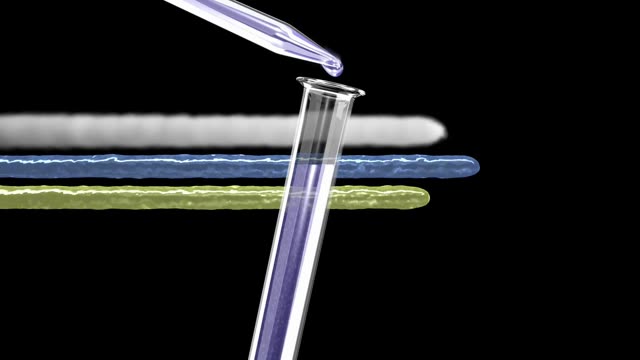 Click to play
Case Studies
Municipal Wastewater Treatment · Electromagnetic flow meter — Application Case
Site Conditions
This is a Municipal Wastewater Treatment customer whose plant is at the inlet, biological and outlet stages of a municipal plant. The main task was volumetric flow of conductive liquids.
The Problem
The difficulty lies in high solids and corrosive fractions, with large diurnal flow swings; at the same time effluent parameters drift and probes foul with sludge and biofilm. Specification therefore means choosing liner and electrode pairing by conductivity, solids and abrasion.
What We Did
We took a flow range approach — flow solution matched to line size, medium and range. Delivery was built around choosing liner and electrode pairing by conductivity, solids and abrasion, with point-by-point checks on: stable compliance with Grade 1A discharge limits and online data reporting.
Operating Outcome
In service the system performs as intended — no obstruction, so pressure loss is minimal and upkeep low, with routine maintenance falling noticeably.
Food & Beverage · Electromagnetic flow meter — Application Case
Application Context
dosing, pasteurising, filling and CIP stages is a typical Food & Beverage duty. The project started from Electromagnetic flow meter, focusing on volumetric flow of conductive liquids.
Process Constraints
frequent cleaning demands instruments that withstand hot CIP/SIP caustic cycles, and syrups, dairy and beverages that scale easily, under strict hygienic requirements only amplify it. The Electromagnetic flow meter specification must therefore cover choosing liner and electrode pairing by conductivity, solids and abrasion.
Delivery Approach
Delivery was handled as the flow range — flow solution matched to line size, medium and range. Execution centred on choosing liner and electrode pairing by conductivity, solids and abrasion, together with food-safety and hygienic design per 3-A / EHEDG.
Field Results
Operation shows the benefit clearly — no obstruction, so pressure loss is minimal and upkeep low, with confidence in this measuring point improving markedly.
Chemical & Pharmaceutical · Electromagnetic flow meter — Application Case
Customer Profile
The typical setting in Chemical & Pharmaceutical is reactors, metering vessels and finished-product tanks. The measuring point is Electromagnetic flow meter; the focus is volumetric flow of conductive liquids.
Key Difficulties
Conditions are highly corrosive media with solvents and crystallisation, partly in explosive atmospheres and, on top of that, corrosion plus Ex protection shortens instrument life and makes downtime costly, which a standard configuration cannot handle for long. The design therefore starts with choosing liner and electrode pairing by conductivity, solids and abrasion.
Implementation
The scope ran through the flow range: flow solution matched to line size, medium and range. Technically it hinges on choosing liner and electrode pairing by conductivity, solids and abrasion, and on these requirements: Ex certification and GMP traceability of records.
Customer Benefit
In practice this means no obstruction, so pressure loss is minimal and upkeep low, which cut the workload on the site maintenance team.
Power & Energy · Electromagnetic flow meter — Application Case
Project Background
The project covers boiler feedwater, turbine condensate and FGD/DeNOx systems. The work centres on Electromagnetic flow meter and the core task is volumetric flow of conductive liquids.
Operating Challenges
The medium and duty are characterised by high temperature and pressure with both steam and saline water, and drift under high temperature and pressure, with very costly unplanned outages. So Electromagnetic flow meter cannot be specified generically — it calls for choosing liner and electrode pairing by conductivity, solids and abrasion.
Solution
The Ainstru engineering team worked through the flow range: flow solution matched to line size, medium and range. The configuration involves choosing liner and electrode pairing by conductivity, solids and abrasion, with these requirements in view: compliance with power-industry codes and unit availability targets.
Results
Since start-up the system has run steadily; the practical result is no obstruction, so pressure loss is minimal and upkeep low.
Related Products
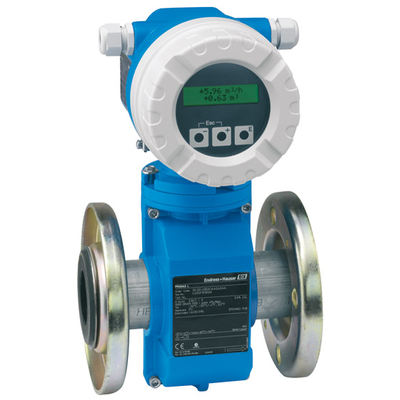 Endress+Hauser
Electromagnetic flowmeter
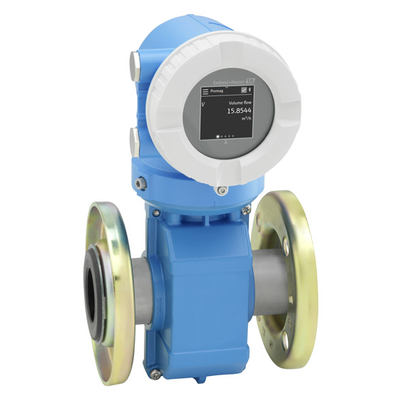 Endress+Hauser
Electromagnetic flowmeter 10
 Endress+Hauser
Electromagnetic flowmeter
 Endress+Hauser
Electromagnetic flowmeter
 Endress+Hauser
Battery-powered electromagnetic flowmeter
 Endress+Hauser
MAGPHANT
 Endress+Hauser
Electromagnetic flowmeter
 Endress+Hauser