
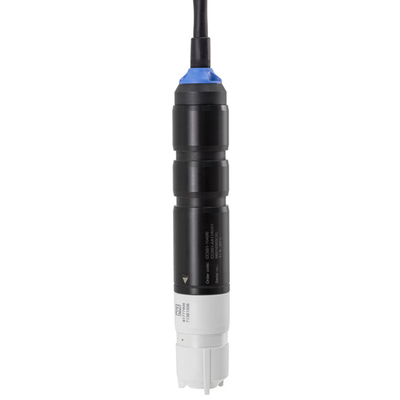
Technical Data
CompareDisinfection
| Measuring Principle | Free chlorine |
| Application | Drinking water - to ensure reliable disinfection Process water - wide range of application due to large measuring range Food - to secure absence/presence of free chlorine Pool water -efficient dosing thanks to precise measurement |
| Characteristic | Amperometric measurement of dissolved free chlorine |
| Measuring range | Trace: 0 to 5 mg/l HOCl Standard: 0 to 20 mg/l HOCl |
| Measuring method | - Closed, membrane covered measuring cell - Reduction of free chlorine at the cathode |
| Design | Closed amperometric 2-electrode measuring cell with PVDF membrane |
| Material | Sensor shaft: POM Membrane: PVDF Membrane cap: PVDF |
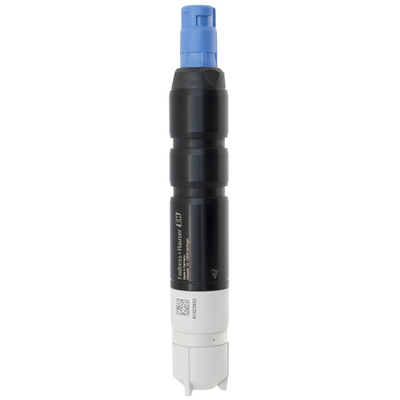
| Dimension | Diameter: 25 mm (0.98 in) Length: 161 mm (6.34 in) |
| Process temperature | +0 to 55 °C (32 to 130°F), non-freezing |
| Process pressure | 1 bar (14.5 psi) |
| Temperature sensor | 10k NTC |
| Connection | analog with fixed cable |
The CCS51 free chlorine sensor is robust and low-maintenance. The sensor performs highly accurate measurement with high long-term stability in drinking water, pool water and process water; it can also reliably monitor the disinfection process even under low-flow conditions. The analog free chlorine sensor has a short response time, ensuring efficient process control and process safety. The CCS51 analog free chlorine sensor provides continuous measured values at the measuring point.
Benefits
Short response time (t90 < 25 seconds) with highly accurate display of the process status, enabling timely action in response to process changes and efficient process control.
Higher process safety: precise, long-term stable measurement enables permanent process monitoring and flexible adjustment of the disinfectant concentration as required.
The fluorescence sensor is low-maintenance and significantly reduces the operating costs of the measuring point compared with colorimetric measuring systems.
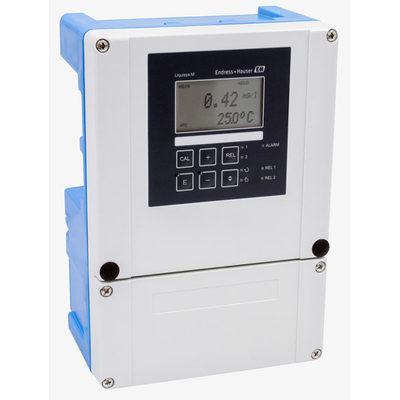
Used together with the Liquisys chlorine transmitter, it provides continuous analog free chlorine measured values at the measuring point.
Applications
The CCS51 free chlorine sensor meets the requirements of skid manufacturers and end users. It reliably measures:
Drinking water: ensuring reliable disinfection
Food: ensuring food safety with hygienic bagged and bottled packaging
Utilities: detecting the presence of free chlorine
Pool water: efficient disinfectant dosing
Spare Parts & Accessories 9
9 spare parts · click to collapse
| Order code | Description | |
|---|---|---|
| CCV05- | Maintenance Kit CCV05Memosens CCSxxD/fixed cable sensor CCSxx | Enquire |
| 71372025 | CCA250 adapter kit CCS5x + CCS5xD | Details |
| 71372026 | CYA112 adapter kit CCS5x + CCS5xD | Details |
| 71372027 | CCA151 adapter kit CCS5x + CCS5xD, incl.: retaining ring, thrust ring, sealing ringContent: Clamp ring, thrust ring, + sealing | Details |
| 71554885 | Adapter kit CCS5x(D/E) for CYA27-xxxB* | Details |
| COY8- | Zero-Point Gel COY8Zero point: Verification, calibration, adjustment at zero point of oxygen and disinfection sensors ::Amperometric and optical sensors ::12, 25 and 40mm diameter ::Application in the lab, in the field | Enquire |
| 71257946 | Handheld DPD Colorimetric Calibrator PF-3colorimetric measurement of free and total chlorine 0,05 - 6mg/l Disinfection, drinking and process water hand held photometer, IP67-graded, with cuvettes, DPD, according to ISO 7393 delivery in plastic case, test kit for free and total chlorine included hand-held photometer for calibration and verification of disinfection loops | Details |
| 50005181 | Junction box VBCFor extension of CMK measuring cable Protection class: IP65 | Details |
| 50035461 | DPD No.1 Tablets (100 tablets)100 pcs., for free chlorine or chlorine dioxide | Details |
Configurator / Comparison
A
Measurement principle video
 Click to play
Source: Endress+Hauserpublic information from the website
Manuals & Documents 4
All documents for this modelCase Studies
Municipal Wastewater Treatment · sterilize — Application Case
Customer Profile
The typical setting in Municipal Wastewater Treatment is the inlet, biological and outlet stages of a municipal plant. The measuring point is sterilize; the focus is monitoring and controlling disinfectant dosing and efficacy.
Key Difficulties
Conditions are high solids and corrosive fractions, with large diurnal flow swings and, on top of that, effluent parameters drift and probes foul with sludge and biofilm, which a standard configuration cannot handle for long. The design therefore starts with matching monitoring points to the disinfection route (chlorine, UV, ozone).
Implementation
The scope ran through the analyser range: selecting as part of a complete water-analysis system. Technically it hinges on matching monitoring points to the disinfection route (chlorine, UV, ozone), and on these requirements: stable compliance with Grade 1A discharge limits and online data reporting.
Customer Benefit
In practice this means on-demand dosing, lowering both by-products and cost, which cut the workload on the site maintenance team.
Food & Beverage · sterilize — Application Case
Project Background
The project covers dosing, pasteurising, filling and CIP stages. The work centres on sterilize and the core task is monitoring and controlling disinfectant dosing and efficacy.
Operating Challenges
The medium and duty are characterised by syrups, dairy and beverages that scale easily, under strict hygienic requirements, and frequent cleaning demands instruments that withstand hot CIP/SIP caustic cycles. So sterilize cannot be specified generically — it calls for matching monitoring points to the disinfection route (chlorine, UV, ozone).
Solution
The Ainstru engineering team worked through the analyser range: selecting as part of a complete water-analysis system. The configuration involves matching monitoring points to the disinfection route (chlorine, UV, ozone), with these requirements in view: food-safety and hygienic design per 3-A / EHEDG.
Results
Since start-up the system has run steadily; the practical result is on-demand dosing, lowering both by-products and cost.
Chemical & Pharmaceutical · sterilize — Application Case
Project Overview
The site is reactors, metering vessels and finished-product tanks. The customer wanted sterilize properly configured on the existing plant, with the aim of monitoring and controlling disinfectant dosing and efficacy.
Technical Challenges
What actually causes trouble is highly corrosive media with solvents and crystallisation, partly in explosive atmospheres, and corrosion plus Ex protection shortens instrument life and makes downtime costly. All of this means the sterilize configuration has to involve matching monitoring points to the disinfection route (chlorine, UV, ozone).
Configuration
Supply and installation were organised through the analyser range: selecting as part of a complete water-analysis system. On site this meant matching monitoring points to the disinfection route (chlorine, UV, ozone), checked line by line against: Ex certification and GMP traceability of records.
Performance
After commissioning the outcome is on-demand dosing, lowering both by-products and cost, and the readings are now used for process tuning.
Power & Energy · sterilize — Application Case
Site Conditions
This is a Power & Energy customer whose plant is at boiler feedwater, turbine condensate and FGD/DeNOx systems. The main task was monitoring and controlling disinfectant dosing and efficacy.
The Problem
The difficulty lies in high temperature and pressure with both steam and saline water; at the same time drift under high temperature and pressure, with very costly unplanned outages. Specification therefore means matching monitoring points to the disinfection route (chlorine, UV, ozone).
What We Did
We took a analyser range approach — selecting as part of a complete water-analysis system. Delivery was built around matching monitoring points to the disinfection route (chlorine, UV, ozone), with point-by-point checks on: compliance with power-industry codes and unit availability targets.
Operating Outcome
In service the system performs as intended — on-demand dosing, lowering both by-products and cost, with routine maintenance falling noticeably.
Related Products
 Endress+Hauser
Free chlorine sensor
 Endress+Hauser
Chloromax CCS 142D
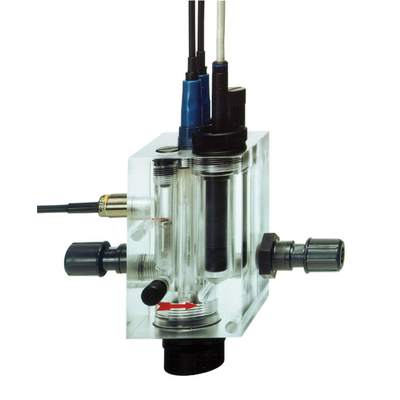 Endress+Hauser
FLOWFIT-W CCA250
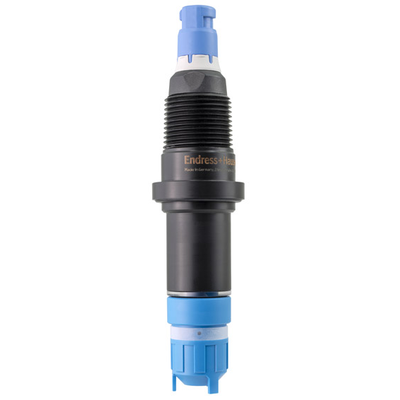 Endress+Hauser
Memosens CCS120D
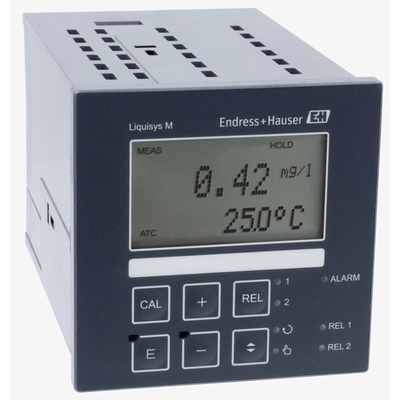 Endress+Hauser
Liquisys M CCM223
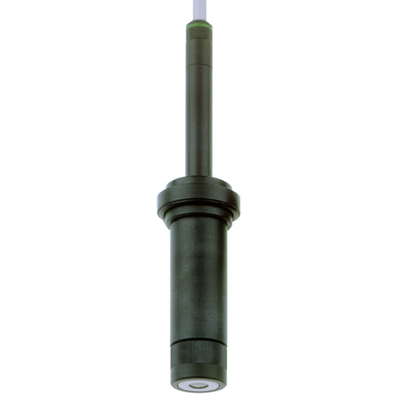 Endress+Hauser
Chlorine sensor cell CCS140
 Endress+Hauser
Liquisys M CCM253
 Endress+Hauser